
Standing Barbell Calf Raise: How To, Muscles Worked & Common Mistakes
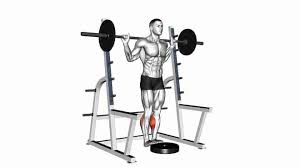
The standing barbell calf raise is one of the most effective exercises for building calf size and strength. It’s the standing variation of the calf raise — which means your knees stay straight throughout — and this position specifically targets the gastrocnemius, the large two-headed muscle that gives the calf its prominent, rounded shape. The barbell allows you to progressively load the movement over time, making it a solid choice for lifters who want to build serious calf development.
Calves are notoriously stubborn muscles to grow — and one of the main reasons is that most people don’t train them through a full range of motion or with enough controlled tension. This page will fix that.
Standing Barbell Calf Raise – Muscles Worked
Primary muscles:
- Gastrocnemius — the large, visible calf muscle with two heads (medial and lateral). The standing position with straight knees maximizes gastrocnemius activation because this muscle crosses both the ankle and knee joints.
Secondary muscles:
- Soleus — the flatter muscle underneath the gastrocnemius, also works during the raise but is more heavily targeted in seated variations with bent knees
- Tibialis posterior — assists with stabilizing the ankle throughout the movement
- Peroneals — the muscles along the outer shin, work as ankle stabilizers throughout
How to Perform the Standing Barbell Calf Raise
- Set a barbell in a squat rack at about shoulder height. Place a weight plate or calf raise platform flat on the floor under the rack.
- Step under the bar and position it across your upper traps — same as a squat. Unrack the bar and step onto the edge of the platform so the balls of your feet are on the platform and your heels hang off the back.
- Stand with feet hip-width apart, toes pointing forward or very slightly outward.
- Let your heels drop below the platform to get a full stretch in your calves at the bottom — this is your starting position.
- Push through the balls of your feet and raise your heels as high as possible, coming up onto your tiptoes.
- At the top, squeeze your calves as hard as you can and hold for 1–2 seconds.
- Slowly lower your heels back below the platform over 2–3 seconds, feeling the full stretch at the bottom.
- Repeat for your desired reps.
Standing Barbell Calf Raise Pro tip: The full stretch at the bottom is just as important as the squeeze at the top — maybe more so. Calves respond particularly well to training through a complete range of motion. Letting your heels drop below the platform on every rep and pausing briefly in that stretched position before raising is one of the most effective techniques for stimulating calf growth.
Standing Barbell Calf Raise – Sets & Reps
| Goal | Sets | Reps | Rest |
|---|---|---|---|
| Muscle building | 3–4 | 10–15 | 60–90 sec |
| Strength | 4–5 | 6–8 | 2 min |
| Endurance / pump | 3 | 20–25 | 45 sec |
Note: Calves are used to high volumes of walking and standing every day, making them more resistant to fatigue than most muscles. Many lifters find that higher rep ranges (15–25) work particularly well for calf development.
Standing Barbell Calf Raise – Common Mistakes to Avoid
1. Not using a full range of motion This is the most common and most damaging calf raise mistake. Doing short, bouncy partial reps where your heels never drop below neutral means your calves barely stretch on each rep. The stretch at the bottom is where growth happens — always use a platform and let your heels drop.
2. Bouncing at the bottom Using the stretch reflex to bounce out of the bottom position removes the tension from the calves at the most important point of the movement. Pause briefly at the bottom, feel the stretch, then raise under muscle control.
3. Not pausing at the top Rushing through reps without pausing at the top means your calves never fully contract. Hold the peak contraction for a full second or two on every rep — this is what your existing page tip correctly mentions.
4. Going too heavy Heavy weight with poor range of motion is far less effective than moderate weight with a full stretch and a hard squeeze. The calves are a muscle that responds to quality reps, not just load.
5. Toes pointing too far outward or inward Foot angle changes which part of the gastrocnemius is emphasized. Toes straight forward or very slightly out is the neutral starting point. Extreme toe angles reduce stability and can stress the ankle joint over time.
Standing Barbell Calf Raise – Foot Angle and Emphasis
Small changes to foot angle shift the emphasis within the calf:
- Toes straight forward — balanced gastrocnemius activation across both heads
- Toes slightly outward — slightly more inner gastrocnemius (medial head) emphasis
- Toes slightly inward — slightly more outer gastrocnemius (lateral head) emphasis
The differences are subtle — the most important thing is always a full range of motion regardless of foot angle.
How the Standing Barbell Calf Raise Compares to the Other Calf Raise Variations
You have three calf raise pages on your site — here’s how they differ:
- Standing barbell calf raise (this page) — knees straight, maximum gastrocnemius activation, allows heavy loading with a barbell
- Barbell seated calf raise — knees bent at 90 degrees, shifts emphasis to the soleus.
- Calf raises on leg press machine — feet on the leg press platform, bent knee position similar to seated, different feel and angle.
For complete calf development, using both standing and seated variations is ideal — standing for the gastrocnemius, seated for the soleus.
Where It Fits in Your Workout
The standing barbell calf raise works best at the end of your leg session after your compound movements. Calves recover relatively quickly between sets and sessions, so they can be trained with higher frequency than most muscle groups — many lifters train calves 2–3 times per week with good results.