Barbell Seated Calf Raise: How To, Muscles Worked & Common Mistakes
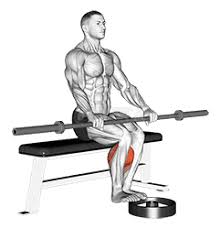
The barbell seated calf raise is the best exercise for directly targeting the soleus — the flat, wide muscle that sits underneath the gastrocnemius. Most people focus all their calf training on standing variations, which primarily work the gastrocnemius. But the soleus is actually the larger of the two calf muscles by volume, and developing it is what adds that thick, full look to the calf from every angle — not just when the leg is straight.
If your calves aren’t growing despite consistent training, adding seated calf raises to your routine is often the missing piece.
Why the Seated Position Targets the Soleus
This is the most important thing to understand about calf anatomy and why this exercise exists:
The gastrocnemius crosses both the ankle and the knee joint. When your knee is straight (as in standing variations), the gastrocnemius is fully active. But when your knee is bent to 90 degrees — as in the seated position — the gastrocnemius is already in a shortened position and contributes far less to the movement. This leaves almost all the work to the soleus, which only crosses the ankle joint and is equally active regardless of knee angle.
This is why standing calf raises = gastrocnemius dominant and seated calf raises = soleus dominant. Both muscles need to be trained for complete calf development. Check out our Standing Barbell Calf Raise page for the gastrocnemius-focused version.
Barbell Seated Calf Raise – Muscles Worked
Primary muscles:
- Soleus — the flat, wide calf muscle underneath the gastrocnemius, the primary target in any seated calf raise. A well-developed soleus adds significant width and thickness to the calf.
Secondary muscles:
- Gastrocnemius — still contributes but is significantly reduced due to the bent knee position
- Tibialis posterior — assists with ankle stabilization throughout
- Peroneals — assist with lateral ankle stability throughout
How to Perform the Barbell Seated Calf Raise
- Sit on a flat bench with your feet flat on a weight plate or calf raise platform, positioned so the balls of your feet are on the edge and your heels can drop freely below.
- Place a barbell across your lower thighs — just above your knees. Use a folded towel or pad under the bar for comfort.
- Your knees should be bent at roughly 90 degrees throughout the entire exercise.
- Let your heels drop below the platform to get a full stretch in the soleus — this is your starting position.
- Push through the balls of your feet and raise your heels as high as possible.
- Squeeze hard at the top and hold for 1–2 seconds.
- Slowly lower your heels back below the platform over 2–3 seconds, feeling the full soleus stretch at the bottom.
- Repeat for your desired reps.
Barbell Seated Calf Raise Pro tip: Place a folded towel or a thin pad under the barbell where it rests on your thighs. Without padding the bar digs uncomfortably into the thigh bone which limits how much weight you can use and distracts from focusing on the calf contraction. A simple pad makes this exercise dramatically more comfortable.
Barbell Seated Calf Raise – Sets & Reps
| Goal | Sets | Reps | Rest |
|---|---|---|---|
| Muscle building | 3–4 | 10–15 | 60–90 sec |
| Strength | 4–5 | 6–8 | 2 min |
| Endurance / pump | 3 | 20–25 | 45 sec |
Like all calf exercises, the seated calf raise responds well to higher rep ranges. The soleus in particular has a high proportion of slow-twitch muscle fibers, making it especially responsive to higher volume and sustained time under tension.
Barbell Seated Calf Raise – Common Mistakes to Avoid
1. Not using a full range of motion The same principle as the standing version — partial reps that skip the heel drop at the bottom mean the soleus never gets fully stretched. Always use a platform and let your heels drop below it on every rep. The stretch is where the growth stimulus happens.
2. Bouncing at the bottom Using the stretch reflex to bounce out of the bottom position removes the tension from the soleus at the most critical point. Pause briefly at the bottom, feel the stretch, then raise under muscle control.
3. Bar too far up the thigh Placing the bar too high up toward your hip reduces the load on your calves because the lever arm changes. The bar should sit just above your knee on your lower thigh for optimal loading.
4. Not padding the bar Without a pad the barbell digs into the thigh bone uncomfortably, limiting how much weight you can use and making it hard to focus on the calf. Always use a towel or pad.
5. Knees drifting inward or outward Keep your knees pointing in line with your toes throughout. Letting them drift changes the ankle mechanics and reduces soleus isolation.
Where It Fits in Your Workout
The barbell seated calf raise works best at the end of your leg session alongside or after your standing calf raise work. The ideal calf training approach is to combine both — standing raises for the gastrocnemius, seated raises for the soleus — giving you complete development of both calf muscles. Many lifters do one set of standing raises followed immediately by one set of seated raises as a superset, cycling through 3–4 rounds for a thorough calf workout.