

Chest Dips: How To, Muscles Worked & Common Mistakes
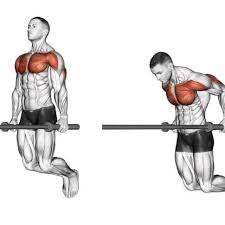
Chest dips are one of the most effective bodyweight exercises for building lower chest size and strength. They’re a step up from push-ups in terms of difficulty — and the results show it. When done with the right technique, chest dips provide a deep stretch and powerful contraction in the lower pecs that very few other exercises can match.
The key to making dips a chest exercise rather than a triceps exercise comes down to one thing: your body angle. More on that below.
Chest Dips vs. Triceps Dips
These two exercises use the same equipment but feel completely different when done correctly:
- Chest dips — torso leaning forward, elbows flare slightly outward, deeper descent. Lower chest does most of the work.
- Triceps dips — torso upright, elbows stay close to the body. Triceps do most of the work.
If you want to target your chest, the forward lean is everything. Check out our Triceps Dips page for the triceps-focused version.
Chest Dips – Muscles Worked
- Pectoralis major (lower portion) — the primary target when leaning forward
- Triceps brachii — heavily involved in locking out each rep
- Anterior deltoid — the front shoulder assists throughout the movement
- Serratus anterior — stabilizes the shoulder blade during the dip
How to Perform Chest Dips
- Grip the parallel bars firmly and press yourself up to the starting position — arms fully extended, body straight.
- Lean your torso forward — this is the most important cue. Aim for roughly 30–45 degrees forward. The more you lean, the more chest involvement you get.
- Allow your elbows to flare slightly outward as you lower yourself — this opens up the chest and increases the stretch.
- Lower yourself slowly until your upper arms are roughly parallel to the ground, or slightly below if your shoulder mobility allows.
- Press through your palms and push yourself back up to the starting position.
- Repeat for your desired reps.
Pro tip: Keep your shoulders pulled down and back throughout the movement — don’t let them creep up toward your ears. Shrugging your shoulders during dips is a fast track to shoulder strain.
Chest Dips – Sets & Reps
| Level | Sets | Reps | Rest |
|---|---|---|---|
| Beginner | 2–3 | 5–8 | 90 sec |
| Intermediate | 3–4 | 10–15 | 60–90 sec |
| Advanced | 4–5 | 15–20+ | 60 sec |
Chest Dips – Common Mistakes to Avoid
1. Not leaning forward enough If you stay upright during dips, your triceps take over almost completely. Consciously lean your chest forward before you even start lowering yourself and maintain that angle throughout the set.
2. Not going deep enough A shallow dip means minimal chest stretch and minimal results. Lower until your upper arms are at least parallel to the floor — that’s where the chest really gets activated.
3. Shrugging your shoulders As fatigue sets in, it’s easy to let your shoulders rise up. This puts unnecessary strain on the shoulder joints and can lead to injury over time. Focus on keeping your shoulders down and back on every rep.
4. Flaring elbows too wide A slight outward flare is good for chest dips — but going too wide puts your shoulder joints under a lot of stress. Keep it controlled and comfortable.
5. Dropping too fast Lowering yourself with control (2–3 seconds down) builds more muscle than dropping quickly. The eccentric phase — the lowering part — is where a lot of the chest stimulus comes from.
Chest Dips – Progressions & Modifications
Not there yet? No problem — here’s how to scale up or down:
- Assisted dips — use an assisted dip machine or loop a resistance band around the bars and under your knees to reduce the load
- Negative dips — jump to the top position and lower yourself as slowly as possible, building strength before you can do full reps
- Weighted dips — once bodyweight dips feel easy, add a weight plate using a dip belt to keep progressing
Where Chest Dips Fit in Your Workout
Chest dips work well as a compound movement early in your chest session, or as a bodyweight finisher toward the end. They pair especially well after the bench press or as a superset with push-ups for an intense bodyweight chest burnout.