

Side Lateral Raise: How To, Muscles Worked & Common Mistakes
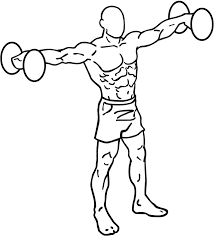
If there’s one exercise that’s responsible for building that wide, capped shoulder look, it’s the side lateral raise. It directly isolates the lateral deltoid — the middle head of the shoulder — which is the muscle most responsible for shoulder width. No amount of bench pressing or overhead pressing fully replaces it, because those movements primarily work the front of the shoulder.
Simple to learn, easy to do anywhere with a pair of dumbbells, and incredibly effective when done correctly. Let’s break it down.
Side Lateral Raise – Muscles Worked
Primary muscles:
- Lateral deltoid — the middle head of the shoulder, the primary driver of shoulder width, directly isolated by the raising motion
Secondary muscles:
- Anterior deltoid — the front shoulder assists slightly throughout the lift
- Supraspinatus — a rotator cuff muscle that initiates the abduction movement
- Trapezius (upper) — assists at the top of the range of motion
- Core — stabilizes your torso throughout the standing movement
How to Perform the Side Lateral Raise
- Stand with a dumbbell in each hand at your sides, palms facing your body. Feet shoulder-width apart, slight bend in the knees.
- Keep a soft, consistent bend in your elbows throughout — this protects your elbow joints and keeps the focus on your lateral delts.
- Raise both dumbbells out to the sides simultaneously in a wide arc, leading with your elbows rather than your hands.
- Raise until your arms are parallel to the floor — your body should form a T shape at the top.
- At the top, tilt the front of the dumbbell very slightly downward — like pouring water out of a jug. This external rotation cue maximizes lateral delt activation.
- Slowly lower the dumbbells back to your sides under control — don’t let them drop.
- Repeat for your desired reps.
Side Lateral Raise Pro tip: Think about raising your elbows, not your hands. Your hands just happen to be holding the dumbbells — the movement is driven by your elbows travelling upward and outward. This mental shift makes a big difference in where you feel the exercise.
Side Lateral Raise – Sets & Reps
| Goal | Sets | Reps | Rest |
|---|---|---|---|
| Muscle building | 3–4 | 12–15 | 60 sec |
| Definition / pump | 3–4 | 15–20 | 45 sec |
| Superset finisher | 2–3 | 20–25 | Minimal |
The lateral deltoid is a relatively small muscle that responds well to moderate weight and higher reps. Most people use significantly less weight here than on other shoulder exercises — and that’s exactly right.
Side Lateral Raise – Common Mistakes to Avoid
1. Going too heavy This is by far the most common lateral raise mistake. Heavy dumbbells force you to use momentum and your traps to swing the weight up — your lateral delts barely do any work. Use a weight where you can feel a genuine burn in the side of your shoulder, not just your traps. For most people this means going lighter than feels natural at first.
2. Shrugging your shoulders As the weight gets heavier or fatigue sets in, your upper traps kick in and your shoulders start to shrug upward. Keep your shoulders actively pulled down throughout every rep — this keeps the work in your lateral delts where it belongs.
3. Swinging the weight with momentum Using a slight body sway to help initiate the raise removes the load from your lateral delts right at the point where they’re most challenged — the bottom of the movement. Keep your torso still and raise with strict muscle control.
4. Raising too high Going above parallel starts to shift the load onto your upper traps rather than your lateral delts. Stop at parallel — that’s all you need for maximum lateral delt activation.
5. Letting the dumbbells drop quickly The slow, controlled lowering phase is extremely important. Dropping the dumbbells quickly removes all the eccentric tension from your lateral delts. Lower over 2–3 seconds and you’ll see significantly better results over time.
6. Elbows dropping below your hands Your elbows should always be at the same height or slightly higher than your hands during the raise. If your elbows are lower, you’ve turned it into a front raise rather than a lateral raise.
Side Lateral Raise – Variation
For constant tension throughout the full range of motion, try the cable version using a low pulley. The cable keeps your lateral delt loaded even at the bottom of the movement where dumbbells provide almost no resistance. Check out our Standing Low Pulley Delt Raise page for the full breakdown of the cable variation.
Where It Fits in Your Workout
The side lateral raise is an isolation exercise and belongs in the middle-to-end portion of your shoulder session, after your heavy compound pressing work. It’s one of the few exercises that directly targets the lateral deltoid, so it’s a non-negotiable if shoulder width is a goal. Many lifters include it in every shoulder session, sometimes for multiple sets at higher rep ranges to really fatigue the lateral head.