

What Your Hormones Are Actually Doing During a Workout
You walk into the gym, pick up a barbell, and over the next hour your body runs one of the most coordinated chemical operations it’s capable of — and you never feel most of it happening. Hormones surge, dip, and signal in a sequence so precise that, once you understand it, almost every piece of training advice you’ve ever heard suddenly makes sense. Why compound lifts build more muscle. Why rest days aren’t lazy. Why sleep matters more than your pre-workout. It all traces back to what your hormones during exercise are doing.
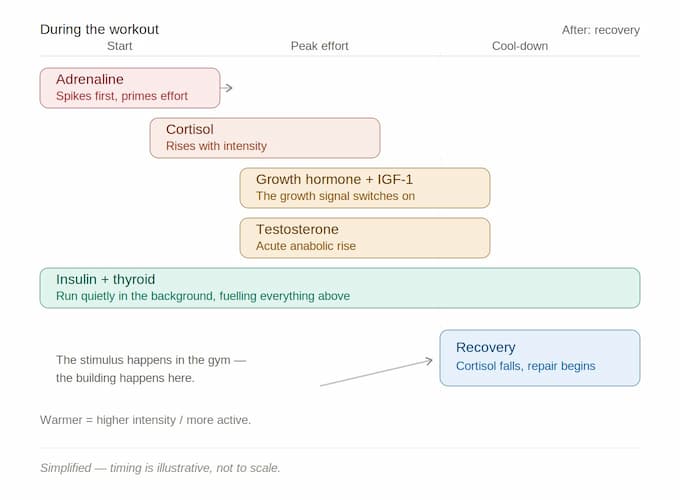
This is the story of that cascade — walked through roughly in the order your body experiences it, from the first rep to the recovery that happens long after you’ve left.
The Moment You Start: Adrenaline Flips the Switch
The first hormone to show up is the one you can actually feel. Within minutes of starting a hard set, your body releases adrenaline — also called epinephrine — the fight-or-flight hormone that primes you for effort.
Adrenaline raises your heart rate, sharpens your focus, and mobilizes stored energy so it’s ready to burn. That “switched on” feeling a few minutes into a session, when the warm-up fog lifts and the weight starts moving better? That’s adrenaline doing its job. It’s the body’s way of saying we’re doing something important now, let’s get the resources in place.
During the Lift: Cortisol, the Misunderstood One
As the intensity climbs, cortisol enters the picture — and cortisol has a worse reputation than it deserves.
You’ve probably heard cortisol called “the stress hormone,” with the implication that it’s something to be avoided. During a workout, that’s the wrong way to think about it. Cortisol is supposed to rise when you train. It helps liberate energy and manage the stress of hard effort, and a healthy cortisol response is part of a productive session.
The problem isn’t acute cortisol from training — it’s chronic cortisol. When stress, poor sleep, and constant under-recovery keep cortisol elevated around the clock, that’s when it starts working against you: blunting recovery, interfering with muscle building, and making fat loss harder. Which is exactly why we’ll come back to recovery at the end — managing cortisol is mostly a matter of what you do outside the gym.
The Growth Signal: Growth Hormone and IGF-1
Here’s where the actual muscle-building machinery gets switched on. Intense training — especially heavy compound movements and sessions with shorter rest periods — triggers a release of growth hormone, which in turn drives the production of IGF-1 (insulin-like growth factor 1).
Together these two are central to tissue repair and growth. Growth hormone supports recovery and the breakdown of fat for fuel; IGF-1 is one of the most directly anabolic signals your body produces, promoting the muscle repair and growth that training is meant to stimulate.
This is also why how you train matters as much as that you train. The training variables that maximise this growth response — compound lifts, sufficient intensity, controlled rest — are exactly the ones covered on our muscle building techniques page. You’re not just moving weight; you’re choosing how loud to make the growth signal.
The Anabolic Backbone: Testosterone and Estrogen
No hormone is more associated with building muscle than testosterone, and for good reason — it’s a primary driver of muscle protein synthesis, strength, and recovery. Training, particularly heavy resistance work, produces an acute rise in testosterone that supports the adaptations you’re working for. It matters for everyone who lifts, in both men and women, just at different baseline levels.
Estrogen deserves a word here too, because it’s badly misunderstood in fitness circles. It isn’t simply a “female hormone” or something men should fear — it plays a legitimate, necessary role in both sexes, supporting recovery, bone health, joint function, and libido. A healthy hormonal environment isn’t about maximizing one hormone and minimizing another; it’s about balance.
Fueling It All: Insulin and Thyroid
Two more hormones run quietly in the background, governing how everything above gets fueled.
Insulin is the nutrient-delivery hormone. After you train, insulin helps shuttle glucose and amino acids into your muscle cells, where they’re used for repair and refueling. This is the physiological reason post-workout nutrition gets so much attention — your muscles are primed to receive nutrients, and insulin is the hormone that drives them in. It’s also why protein and creatine timing get discussed the way they do; you can read our take on the best time to take protein and how creatine fits the same window.
Thyroid hormones — T3 and T4 — are the metabolic thermostat. They set the rate at which your whole system runs, influencing energy levels, how efficiently you burn calories, and how well you recover. When thyroid function is off, everything else feels harder no matter how well you train.
After the Workout: Recovery Is Where the Magic Happens
Here’s the part most people get backwards. The workout is the stimulus — but the actual building happens afterward, during recovery, when your hormonal environment shifts away from stress and toward repair.
In the hours and days after a hard session, growth hormone and the anabolic signals do their repair work, and — crucially — cortisol needs to come back down. This is why sleep and rest aren’t optional extras bolted onto a training plan. They are the training plan, just the half that happens with your eyes closed. Skimp on recovery and you keep cortisol elevated, blunt the growth response, and undercut the very adaptations you trained to produce.
Train hard, then recover just as deliberately. That’s not a motivational slogan — it’s hormonal physiology.
What This Actually Means for How You Train
Strip away the detail and the practical takeaway is simple:
Train hard enough, with the right kind of movements, to trigger the growth signals — that means compound lifts and genuine intensity, not just going through the motions. Recover well enough to keep cortisol in check — that means sleep, rest days, and managing life stress, not just gym time. And eat in a way that supports insulin and thyroid — consistent, sufficient nutrition that gives your hormones something to work with.
Every hormone in this cascade is responding to choices you make. Understanding the system doesn’t just satisfy curiosity; it tells you why the fundamentals are the fundamentals.
If you want to go deeper on any single hormone in the chain, our full hormones section breaks each one down individually — and you can use our macro calculator to set the nutrition targets that keep the whole system running well.