

Bent-Over Low-Pulley Raise: How To, Muscles Worked & Common Mistakes
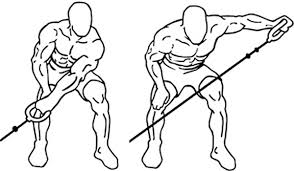
The bent-over low-pulley raise is the cable machine version of the rear delt raise — and the cable makes a meaningful difference. With dumbbells, the resistance is highest when your arm is parallel to the floor and drops off as you lower. With a cable set at floor level, the tension stays constant throughout the entire range of motion, meaning your rear delts are working from the very bottom of the movement all the way to the top.
If you’ve been relying only on dumbbells for your rear delt training, adding this exercise into the rotation is a great way to keep your muscles challenged with a different resistance curve.
Why Cable Tension Matters for Rear Delts
This is the key advantage of this exercise over the dumbbell versions:
- Dumbbells — resistance is gravity-based, meaning tension peaks at parallel and is minimal at the start and end of the movement
- Low pulley cable — resistance is horizontal, meaning the cable pulls your arm back toward the machine throughout the entire arc, loading your rear delt from the very first degree of movement
This constant tension is particularly valuable for smaller isolation muscles like the rear deltoid, which respond well to sustained time under tension. Check out our Dumbbell Rear Lateral Raise page and Reverse Fly page for the dumbbell alternatives.
Bent-Over Low-Pulley Raise – Muscles Worked
Primary muscles:
- Posterior deltoid (rear delt) — the primary target, loaded with constant tension throughout the full range of motion
Secondary muscles:
- Rhomboids — assist with the squeezing motion at the top of each rep
- Trapezius (mid and lower) — helps stabilize and retract the shoulder blade
- Infraspinatus and teres minor — rotator cuff muscles that assist the raising motion
- Core and erector spinae — work to maintain the hinged position throughout the set
How to Perform the Bent-Over Low-Pulley Raise
- Attach a single handle to the low pulley of a cable machine. Stand side-on to the machine and grab the handle with the hand furthest from it — the cable should cross in front of your body.
- Hinge at the hips until your torso is roughly parallel to the floor, knees slightly bent, free hand resting on your thigh or the machine for light support.
- Let your working arm hang down with the cable pulling it toward the machine — this is your starting position with the rear delt already under slight tension.
- With a soft bend in your elbow, raise the handle out and up to the side in a wide arc until your arm is roughly parallel to the floor.
- Squeeze your rear delt and shoulder blade at the top — hold briefly.
- Slowly lower the handle back to the starting position, resisting the cable on the way down.
- Complete all reps on one side, then switch.
Bent-Over Low-Pulley Raise Pro tip: The cross-body cable setup — where the cable comes from the opposite side — actually creates a slightly better line of pull for the rear delt compared to a straight side pull. It keeps the tension more directly on the rear delt throughout the movement rather than shifting toward the traps.
Bent-Over Low-Pulley Raise – Sets & Reps
| Goal | Sets | Reps | Rest |
|---|---|---|---|
| Muscle building | 3–4 | 12–15 per side | 60 sec |
| Definition / endurance | 3–4 | 15–20 per side | 45 sec |
| Superset finisher | 2–3 | 20+ per side | Minimal |
Bent-Over Low-Pulley Raise – Common Mistakes to Avoid
1. Not hinging forward enough Just like with dumbbell rear raises, your torso needs to be roughly parallel to the floor for the rear delts to be the primary mover. Standing too upright shifts the work to your traps. Get horizontal before you start pulling.
2. Using too much weight The cable stack can make it tempting to go heavier than you should. Keep the weight light enough that you can feel a clear contraction in your rear delt — not just your traps hauling the handle around.
3. Letting the cable pull your arm back too fast The eccentric — the slow return to start — is where a lot of the rear delt stimulus comes from with cables. Resist the pull of the cable on the way back down rather than letting it snap your arm back quickly.
4. Shrugging your shoulder Keep your working shoulder down and back throughout the movement. Shrugging brings your upper trap into play and reduces rear delt activation significantly.
5. Bending your elbow too much A soft bend is fine but dramatically bending your elbow turns this into a row. Keep the arm relatively straight and lead with your elbow to keep the focus on your rear delt.
Where It Fits in Your Workout
The bent-over low-pulley raise is an isolation exercise and belongs at the end of your shoulder or back session. Because it’s unilateral it takes a little longer than bilateral exercises, so it works well as a focused finisher when you want to give each rear delt individual attention. It also pairs nicely in a superset with the side lateral raise or front cable raise to hit all three heads of the deltoid in one efficient circuit.