

Standing Low Pulley Delt Raise: How To, Muscles Worked & Common Mistakes
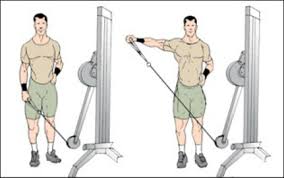
The standing low pulley delt raise is the cable version of the side lateral raise — and while it targets the same muscle, the cable machine changes the resistance profile in a way that makes it a genuinely different and valuable exercise. Where dumbbells provide almost no resistance at the bottom of the movement, the low pulley cable keeps your lateral deltoid loaded throughout the entire range of motion, including right at the start.
Think of this as the perfect complement to the dumbbell lateral raise — together they cover every point in the movement where the lateral delt can be challenged.
Why the Standing Low Pulley Delt Raise Is Different from the Dumbbell Lateral Raise
This is the key point that makes this exercise worth including separately:
- Dumbbell lateral raise — gravity-based resistance, tension is minimal at the bottom and peaks at parallel. The muscle works hardest in the middle of the movement.
- Standing low pulley delt raise — cable-based resistance pulls horizontally, meaning your lateral delt is under tension from the very first degree of movement all the way through. The muscle works consistently throughout the full range.
This constant tension is particularly useful for building the lateral delt through its full range rather than just the mid-point.
Standing Low Pulley Delt Raise – Muscles Worked
Primary muscles:
- Lateral deltoid — isolated throughout the entire range of motion with constant cable tension
Secondary muscles:
- Anterior deltoid — assists slightly throughout the lift
- Supraspinatus — rotator cuff muscle that initiates shoulder abduction
- Trapezius (upper) — assists at the top of the range of motion
- Core — stabilizes your torso throughout the standing movement
How to Perform the Standing Low Pulley Delt Raise
- Attach a single handle to a low pulley cable machine. Stand side-on to the machine, feet shoulder-width apart.
- Reach across your body with the hand furthest from the machine and grab the handle — the cable should cross in front of your lower body. This cross-body setup is the standard for this exercise.
- Stand tall with your working arm hanging down and slightly in front of your body, cable taut. This is your starting position — your lateral delt is already under tension.
- With a soft, consistent bend in your elbow, raise the handle out to the side in a wide arc until your arm reaches parallel with the floor.
- At the top, tilt the front of the handle very slightly downward — the same pouring cue as the dumbbell version — to maximize lateral delt activation.
- Slowly lower the handle back to the starting position, resisting the cable throughout the descent.
- Complete all reps on one side, then switch.
Standing Low Pulley Delt Raise Pro tip: Stand slightly further from the machine than feels natural — this increases the horizontal pull of the cable at the bottom of the movement and maximizes the tension on your lateral delt right from the start of the rep.
Standing Low Pulley Delt Raise – Sets & Reps
| Goal | Sets | Reps | Rest |
|---|---|---|---|
| Muscle building | 3–4 | 12–15 per side | 60 sec |
| Definition / pump | 3–4 | 15–20 per side | 45 sec |
| Superset finisher | 2–3 | 20+ per side | Minimal |
Standing Low Pulley Delt Raise – Common Mistakes to Avoid
1. Standing too close to the machine If you’re too close, the cable angle becomes more vertical and you lose the horizontal tension that makes this exercise unique. Step away from the machine enough that the cable pulls at a low, mostly horizontal angle when your arm is at the bottom.
2. Leaning away from the machine It’s tempting to lean your torso away from the cable to help raise the handle. This reduces the isolation of the lateral delt and starts involving your core and lower back as compensators. Keep your torso upright and still throughout every rep.
3. Letting the cable pull your arm back too quickly The return phase is where a lot of the lateral delt stimulus comes from. Resist the cable slowly on the way down — 2 to 3 seconds — rather than letting it snap your arm back to the starting position.
4. Shrugging your shoulder Same as the dumbbell version — keep your working shoulder actively pulled down throughout. Shrugging brings your upper trap into play and reduces lateral delt isolation significantly.
5. Raising too high Parallel to the floor is your target. Going higher shifts the work to your upper traps and takes it away from the lateral delt. Stop at parallel and squeeze before lowering.
Where It Fits in Your Workout
The standing low pulley delt raise is an isolation exercise and belongs in the middle-to-end portion of your shoulder session. Many lifters use it as a second lateral raise exercise after the dumbbell version — dumbbell lateral raises first for the overload at parallel, cable raises after for the constant tension throughout. Together they give the lateral delt a very complete workout. It also pairs well in a superset with the front cable raise to hit both the lateral and anterior deltoid back to back.