

Front Cable Raise: How To, Muscles Worked & Common Mistakes
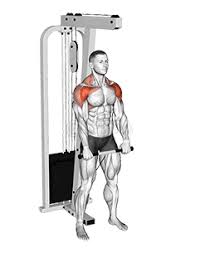
The front cable raise is the cable version of the front raise — and just like with lateral raises, the cable machine offers something the dumbbell version can’t: constant tension from the very bottom of the movement all the way to the top. With dumbbells, there’s almost no resistance when your arm is hanging down. With a low pulley cable behind you, your anterior deltoid is under load from the first inch of movement.
If you already do front dumbbell raises, adding this variation into your rotation is a smart way to challenge your anterior delts with a completely different resistance curve.
How the Front Cable Raise Differs from the Dumbbell Front Raise
Both exercises isolate the anterior deltoid but the resistance profile is different:
- Front dumbbell raise — gravity-based, minimal tension at the bottom, peaks at parallel. Simple and accessible anywhere.
- Front cable raise — horizontal cable tension from behind, loads the anterior delt throughout the entire arc including at the very start of the movement.
The cable version also makes it harder to use momentum since the cable pulls your arm back toward the machine rather than just letting it hang. Check out our Front Dumbbell Raise page and Front Plate Raise page for the free weight alternatives.
Front Cable Raise – Muscles Worked
Primary muscles:
- Anterior deltoid — the front head of the shoulder, directly targeted throughout the full range of motion
Secondary muscles:
- Lateral deltoid — assists slightly as the arm rises
- Clavicular head of pectoralis major — the upper chest contributes at the bottom of the movement
- Serratus anterior — stabilizes the shoulder blade throughout
- Core — stabilizes your torso as you resist the cable pulling behind you
How to Perform the Front Cable Raise
- Attach a single handle to a low pulley. Stand facing away from the machine with your feet shoulder-width apart, one foot slightly forward for balance.
- Grip the handle with one hand, arm hanging at your side. The cable should run behind your leg toward the machine — your anterior delt is already under slight tension at the starting position.
- Keep a soft bend in your elbow and raise the handle straight forward and upward in a smooth arc until your arm is parallel to the floor.
- Hold briefly at the top, feeling the contraction in the front of your shoulder.
- Slowly lower the handle back to the starting position, resisting the cable on the way down.
- Complete all reps on one side, then switch.
Alternative setup: You can also use a rope or straight bar attachment and perform bilateral raises with both arms simultaneously if the machine allows, though the single-arm version gives better control and isolation.
Front Cable Raise Pro tip: Keep your torso completely still throughout. It’s tempting to lean your upper body forward slightly as you raise — this reduces the demand on your anterior delt and lets your chest and core compensate. Stand tall and let the shoulder do all the work.
Front Cable Raise – Sets & Reps
| Goal | Sets | Reps | Rest |
|---|---|---|---|
| Muscle building | 3–4 | 12–15 per side | 60 sec |
| Definition / pump | 3–4 | 15–20 per side | 45 sec |
| Superset finisher | 2–3 | 20+ per side | Minimal |
A note on front raise volume: because the anterior deltoid already gets significant work from pressing exercises like the bench press and shoulder press, front raises typically don’t need as much volume as lateral or rear delt raises. Two to three sets is often sufficient.
Front Cable Raise – Common Mistakes to Avoid
1. Raising too high Parallel to the floor is the target. Going higher than that shifts stress to the shoulder joint and reduces anterior delt activation. Stop at parallel and squeeze.
2. Letting the cable pull your arm back too fast The slow return against the cable resistance is a big part of what makes this exercise effective. Resist it deliberately over 2–3 seconds rather than letting the cable snap your arm back.
3. Swinging your torso A common compensation when the weight is too heavy. Keep your core braced and your torso completely still — only your arm should move.
4. Locking your elbow A soft bend in the elbow should stay consistent throughout. Straightening your arm fully puts unnecessary stress on the elbow joint and shifts the focus away from the shoulder.
5. Over-rotating the wrist Your palm should face down at the top of the movement — neutral to slightly pronated. Rotating excessively inward or outward changes the line of pull and reduces anterior delt isolation.
Where It Fits in Your Workout
The front cable raise is an isolation exercise and belongs toward the end of your shoulder session. Because the anterior deltoid already gets substantial indirect work from pressing movements, front raises are usually done with less volume than lateral or rear delt work. They pair well in a superset with the standing low pulley delt raise — front delts and side delts hit back to back — for an efficient anterior and lateral shoulder finishing circuit.