

Front Dumbbell Raise: How To, Muscles Worked & Common Mistakes
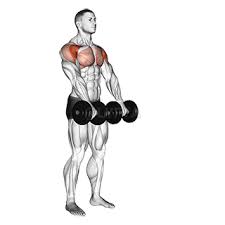
The front dumbbell raise is a classic shoulder isolation exercise that directly targets the anterior deltoid — the front head of your shoulder. It’s straightforward, requires minimal equipment, and is a staple in shoulder routines across all fitness levels.
While pressing movements like the bench press and overhead press do work the anterior delt as a secondary muscle, the front raise isolates it directly — making it a valuable addition for anyone focused on complete shoulder development and that full, rounded shoulder look from every angle.
Front Dumbbell Raise – Muscles Worked
Primary muscles:
- Anterior deltoid — the front head of the shoulder, the primary driver of the forward raising motion
Secondary muscles:
- Lateral deltoid — assists slightly as the arm rises
- Clavicular head of pectoralis major — the upper chest contributes at the bottom of the movement where the arm starts to lift
- Serratus anterior — stabilizes the shoulder blade throughout
- Core — braces to keep your torso stable and prevent leaning back
How to Perform the Front Dumbbell Raise
- Stand with your feet shoulder-width apart, a dumbbell in each hand resting in front of your thighs. Palms should face your body or slightly inward — either is fine.
- Keep a soft, consistent bend in your elbows throughout.
- Raise one or both dumbbells straight forward and upward in a smooth arc, keeping your arm in line with your shoulder — not crossing your midline.
- Raise until your arm is parallel to the floor — your palm should be facing down at the top.
- Hold briefly and squeeze your anterior delt at the top.
- Slowly lower the dumbbell back to the starting position over 2–3 seconds.
- Repeat for your desired reps — alternating arms or both simultaneously.
Alternating vs. simultaneous: Alternating arms lets you focus more on each side individually and gives the working shoulder a brief rest between reps. Doing both at once increases the challenge and reduces total set time. Both approaches are valid — alternate for more control, simultaneous for more intensity.
Front Dumbbell Raise Pro tip: Keep your thumb slightly higher than your pinky at the top of the movement — a very slight internal rotation. This small adjustment keeps the line of pull directly through the anterior delt and maximizes the contraction at the top.
Front Dumbbell Raise – Sets & Reps
| Goal | Sets | Reps | Rest |
|---|---|---|---|
| Muscle building | 3–4 | 10–15 | 60 sec |
| Definition / pump | 3 | 15–20 | 45 sec |
| Superset finisher | 2–3 | 15–20 | Minimal |
Because the anterior deltoid already receives significant indirect work from pressing exercises, front raises generally don’t need high volume. Two to three focused sets is enough for most people.
Front Dumbbell Raise – Common Mistakes to Avoid
1. Using momentum to swing the weight up This is the most common mistake. A slight forward swing makes the weight easier but removes most of the anterior delt activation. Keep your torso still and raise with strict muscle control. If you’re swinging, the weight is too heavy.
2. Raising too high Parallel to the floor is your target — not above your head. Going higher than parallel shifts stress to the shoulder joint and away from the anterior delt. Stop at parallel and squeeze.
3. Crossing your midline The dumbbell should travel straight forward, in line with your shoulder. Letting it drift toward the center of your body changes the angle and reduces anterior delt isolation.
4. Locking your elbow A soft bend protects the elbow joint and keeps the tension in the shoulder. Don’t straighten your arm completely at any point during the movement.
5. Leaning back as you raise Leaning your torso backward helps swing the weight up but turns the exercise into a partial deltoid swing rather than an isolation movement. Brace your core, stay upright, and let the shoulder do the work.
6. Dropping the weight too fast The slow lowering phase keeps your anterior delt under eccentric tension — one of the most important stimuli for muscle growth. Lower deliberately over 2–3 seconds every rep.
Front Dumbbell Raise – Variations
You have two other front raise variations on your site that use different equipment for a different resistance curve:
- Front Cable Raise — cable version that provides constant tension from the very bottom of the movement.
- Front Plate Raise — uses a weight plate instead of dumbbells, naturally promotes a neutral grip which some people find more comfortable.
Rotating between these variations is a great way to keep your anterior delt training fresh and challenge the muscle with different resistance profiles.
Front Dumbbell Raise – Where It Fits in Your Workout
The front dumbbell raise is an isolation exercise and belongs toward the end of your shoulder session after compound pressing work. Since your anterior delts are already well-worked by pressing exercises, front raises are typically programmed with less volume than lateral or rear delt raises — 2 to 3 sets is usually plenty. They pair well in a superset with side lateral raises to hit both the front and side of the shoulder back to back.