

Sit-ups: How To, Muscles Worked & Common Mistakes
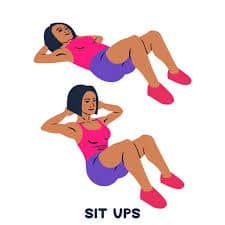
Sit-ups are one of the most classic and recognised core exercises in existence — and one of the most debated. They’ve been a staple of fitness programs, military training, and sports conditioning for decades. Done correctly they effectively work the rectus abdominis through a full range of motion, and also involve the hip flexors more than most other ab exercises.
They’re simple, require no equipment, and can be done anywhere — making them one of the most accessible exercises you can add to your routine.
Sit-Ups vs. Crunches
These two exercises are often confused or used interchangeably but they’re meaningfully different:
- Sit-ups — full range of motion, your entire upper body rises until you’re upright, greater hip flexor involvement, more total movement
- Crunches — partial range of motion, only your shoulders and upper back rise off the floor, more isolated rectus abdominis focus, less hip flexor involvement
Neither is strictly better — they complement each other well and target the abs slightly differently. Check out our Crunches page for the partial range variation.
Sit-Ups – Muscles Worked
Primary muscles:
- Rectus abdominis — the “six-pack” muscle running vertically down the front of the abdomen, the primary mover throughout the sit-up
- Hip flexors (iliopsoas) — heavily involved in the upper portion of the sit-up as you rise toward your knees
Secondary muscles:
- Obliques — assist with stabilization and rotation during the movement
- Transverse abdominis — the deep core muscle that braces throughout
- Neck flexors — assist with lifting the head — though they should not be doing the work
How to Perform Sit-Ups
- Lie flat on your back on a mat with your knees bent and feet flat on the floor, hip-width apart. Bending your knees reduces the hip flexor demand and helps keep the focus on your abs.
- Place your hands behind your head with your elbows pointing outward — or cross your arms over your chest if neck strain is an issue.
- Take a breath, brace your core, and begin to curl your upper body upward by contracting your abs — not by yanking your head forward with your hands.
- Continue rising until your torso is upright and your elbows are near your knees.
- Squeeze your abs at the top briefly.
- Slowly lower yourself back down to the starting position over 2–3 seconds — don’t just drop back down.
- Repeat for your desired reps.
Pro tip: Think about “peeling” your spine off the mat one vertebra at a time as you rise — lower back first, then mid back, then upper back. This controlled spinal flexion keeps the abs under tension throughout the entire ascent and prevents you from using momentum to swing yourself up.
Sit-Ups – Sets & Reps
| Goal | Sets | Reps | Rest |
|---|---|---|---|
| Core strength | 3–4 | 15–20 | 45–60 sec |
| Endurance | 3 | 25–30 | 30–45 sec |
| Weighted progression | 3–4 | 10–15 | 60 sec |
Sit-Ups – Common Mistakes to Avoid
1. Pulling on your neck This is the most common sit-up mistake and one your existing page correctly flags. Yanking your head forward with your hands to help you sit up puts significant strain on your cervical spine and means your abs aren’t doing the work. Your hands behind your head should be there for light support only — think of your elbows as wings staying wide, not pulling forward.
2. Using momentum to swing up Jerking your upper body up with a fast swing removes the ab tension at the start of the movement. Start each rep by contracting your abs first, then slowly rise. The slower you go, the more your abs work.
3. Feet flying up If your feet are coming off the floor as you rise, your hip flexors are dominating and your abs are doing very little. Make sure your feet are anchored — either under a sofa, held by a partner, or using a sit-up bench with foot holders — and focus on the abdominal contraction.
4. Straight legs Doing sit-ups with straight legs dramatically increases hip flexor involvement and reduces rectus abdominis activation. Always keep your knees bent to shift the focus to your abs.
5. Dropping back too fast The slow, controlled lowering phase keeps your abs under eccentric tension throughout the descent. Dropping back down quickly removes this stimulus entirely — lower deliberately over 2–3 seconds every rep.
How to Make Sit-Ups Harder
Once bodyweight sit-ups feel easy, here’s how to keep progressing:
- Weighted sit-ups — hold a weight plate or dumbbell on your chest as you perform the movement
- Decline sit-ups — perform on a decline bench with your head lower than your feet, significantly increases the difficulty
- Slow tempo sit-ups — take 3–5 seconds to rise and 3–5 seconds to lower, eliminating all momentum and maximizing time under tension
Where Sit-Ups Fit in Your Workout
Sit-ups work well at the end of any training session as part of a core circuit, or as a standalone ab workout on rest days. Because they require no equipment they’re also great for home training and travel workouts. Many lifters pair them with crunches, oblique work, and planks for a comprehensive core session that covers all areas of the midsection.