
Crunches: How To, Muscles Worked & Common Mistakes
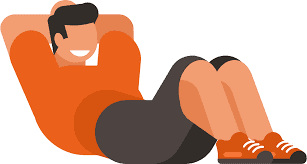
Crunches are the most popular ab exercise in the world — and when done correctly, they’re genuinely one of the most effective ways to isolate and develop the rectus abdominis. Unlike sit-ups which take your upper body all the way up, crunches use a short, deliberate range of motion that keeps constant tension on the abs throughout the entire movement and largely removes the hip flexors from the equation.
Less range of motion, more ab isolation. That’s the crunch in a nutshell.
Crunches vs. Sit-Ups
These two exercises look similar but target your abs differently:
- Crunches — only your shoulders and upper back rise off the floor, lower back stays grounded, maximum rectus abdominis isolation, minimal hip flexor involvement
- Sit-ups — your entire torso rises to upright, full range of motion, greater hip flexor involvement alongside the abs
Crunches are generally considered the more direct ab isolation exercise because the shortened range of motion keeps the work almost entirely in the abs rather than letting the hip flexors take over. Check out our Sit-Ups page for the full range version.
Crunches – Muscles Worked
Primary muscles:
- Rectus abdominis — the “six-pack” muscle, directly targeted through the spinal flexion of the crunch. The shortened range of motion keeps it under near-constant tension throughout the set.
Secondary muscles:
- Obliques — assist with stabilization throughout the movement
- Transverse abdominis — the deep core muscle braces throughout to support the spine
- Neck flexors — assist with lifting the head — though they should not be doing the primary work
How to Perform Crunches
- Lie flat on your back on a mat with your knees bent and feet flat on the floor, hip-width apart.
- Place your hands lightly behind your head with your elbows pointing outward — or cross your arms over your chest.
- Press your lower back gently into the mat and keep it there throughout the entire movement — this is what differentiates a crunch from a sit-up.
- Take a breath, then exhale as you contract your abs and curl your shoulders and upper back off the mat — your shoulder blades should clear the floor but your lower back should stay down.
- At the top, squeeze your abs as hard as you can and hold for a brief moment.
- Slowly lower your shoulders back to the mat over 2–3 seconds — don’t just drop back down.
- Repeat for your desired reps.
Pro tip: Imagine there’s a tennis ball under your chin — this keeps the right amount of space between your chin and chest throughout the crunch, preventing neck strain and keeping your cervical spine in a neutral position. Your gaze should be toward the ceiling, not at your knees.
Crunches – Sets & Reps
| Goal | Sets | Reps | Rest |
|---|---|---|---|
| Core strength | 3–4 | 15–25 | 45 sec |
| Endurance | 3 | 30–50 | 30 sec |
| Weighted progression | 3–4 | 12–15 | 60 sec |
Crunches – Common Mistakes to Avoid
1. Pulling on your neck This is the most common crunch mistake. Your hands behind your head are there for light support only — not to yank your head forward on every rep. If your neck hurts after crunches, this is why. Keep your elbows wide and let your abs do the curling, not your hands.
2. Lower back rising off the mat The moment your lower back lifts off the mat, you’ve turned the crunch into a partial sit-up. Keep the lower back pressed into the floor throughout — this is the defining feature of a proper crunch and what keeps the tension directly on the abs.
3. Using momentum Fast, bouncy crunches that use momentum to get through reps mean your abs are barely working. Slow controlled reps with a genuine squeeze at the top beat high-speed volume every time. Quality over quantity.
4. Not squeezing at the top The peak contraction — when your shoulders are off the mat and your abs are fully shortened — is the most valuable part of the crunch. Many people rush through this point without squeezing. Hold for a full second at the top and really contract your abs before lowering.
5. Range of motion too large If you’re going so high that your lower back lifts off the mat, you’ve exceeded the crunch range of motion. The movement is intentionally short — shoulders and upper back rising while the lower back stays down. That’s all it needs to be.
Crunch Variations
Crunches are highly versatile and can be modified in many ways. You have several crunch variations on your site:
- Cross-body crunch — adds rotation to hit the obliques alongside the rectus abdominis.
- Twisting crunch — similar rotational variation.
- Kneeling cable crunch — weighted cable version that allows progressive overload.
How to Make Crunches Harder
Once bodyweight crunches feel easy:
- Weighted crunches — hold a weight plate on your chest as you crunch
- Arms extended overhead — extending your arms above your head during the crunch increases the lever arm and makes it significantly harder
- Feet off the floor — raising your legs to a 90-degree angle removes foot anchoring and increases the ab demand
Where Crunches Fit in Your Workout
Crunches work well at the end of any training session as part of a core circuit. They pair perfectly with oblique work like dumbbell side bends and twisting crunches, and with cable crunches for progressive overload. Because they require no equipment they’re also ideal for home workouts and travel training.