
Twisting Crunch: How To, Muscles Worked & Common Mistakes
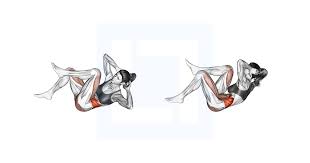
The twisting crunch is a rotational variation of the standard crunch that specifically targets the obliques alongside the rectus abdominis. While the standard crunch moves in a straight line, the twisting crunch adds a deliberate torso rotation at the top of each rep — and that rotation is what fires up the obliques and creates the lateral definition at the sides of your core.
It’s one of the most effective floor exercises for developing the obliques and is a natural progression from standard crunches once you’ve built a solid base of core strength.
Twisting Crunch vs. Cross-Body Crunch
These two exercises are closely related but have a subtle but meaningful difference in focus:
- Twisting crunch — you crunch up and rotate your shoulder toward the same side, holding the rotational contraction at the top. The emphasis is on the oblique squeeze at the peak.
- Cross-body crunch — you bring one elbow diagonally toward the opposite knee in a crossing motion. The emphasis is on the diagonal reach across the body.
Both work the obliques and rectus abdominis through rotation — the twisting crunch isolates the rotational contraction more purely while the cross-body crunch adds the diagonal reaching element. Used together in the same core session they give your obliques a very thorough workout. Check out our Cross-Body Crunch page for the diagonal variation.
Twisting Crunch – Muscles Worked
Primary muscles:
- External obliques — the outer oblique on the side you rotate toward is powerfully contracted at the top of each rep
- Internal obliques — the internal oblique on the opposite side assists with the rotation
- Rectus abdominis — works through the spinal flexion component of the crunch
Secondary muscles:
- Transverse abdominis — braces throughout to support the spine
- Serratus anterior — assists with the rotational component of the movement
- Hip flexors — minimal involvement when the lower back stays on the mat
How to Perform the Twisting Crunch
- Lie flat on your back on a mat with your knees bent and feet flat on the floor, hip-width apart.
- Place your hands lightly behind your head, elbows pointing outward — wide elbows throughout.
- Press your lower back into the mat and keep it there.
- Take a breath, then exhale as you lift your upper back off the mat and rotate your right shoulder toward your left side — your torso twists, not just your neck and head.
- At the top of the rotation, squeeze your oblique hard on the side you’ve twisted toward and hold for a full second.
- Slowly lower back to the starting position over 2 seconds — don’t just drop back down.
- Repeat on the opposite side — left shoulder rotating toward the right.
- Continue alternating for your desired number of reps.
Pro tip: At the top of each rep, think about trying to get your shoulder blade off the mat on the rotating side — not just your elbow pointing across. This cue ensures your torso is actually rotating rather than just your arm swinging sideways. The more your shoulder blade lifts and rotates, the more your oblique is doing the work.
Twisting Crunch – Sets & Reps
| Goal | Sets | Reps | Rest |
|---|---|---|---|
| Core strength | 3–4 | 15–20 per side | 45 sec |
| Oblique endurance | 3 | 25–30 per side | 30 sec |
| Superset with crunches | 3 | 20 per side | Minimal |
Twisting Crunch – Common Mistakes to Avoid
1. Twisting your neck instead of your torso This is the most important mistake to avoid — and your existing page correctly flags it. Turning your head to the side without actually rotating your torso means your neck is doing the work and your obliques are barely involved. The rotation must come from your mid-torso — your ribcage rotating toward the opposite hip.
2. Elbows pulling forward Wide elbows are essential. The moment your elbows pull forward to help generate the rotation, you’ve started using your arms and neck instead of your core. Keep your elbows pointing outward throughout.
3. Lower back lifting off the mat Keep your lower back pressed firmly into the mat throughout. If it rises, reduce the range of the rotation slightly and focus on keeping the lumbar spine grounded.
4. Not holding the squeeze at the top The peak oblique contraction at the top of each rep is the most valuable part of this exercise. Don’t rush through it — hold the twist and squeeze for a full second on every rep before returning to neutral. This is what separates an effective twisting crunch from just going through the motions.
5. Rushing through alternating sides Take each side seriously. A common pattern is to rush the “weaker” side to get it over with — but this builds imbalances over time. Give each side equal time, focus, and contraction quality.
Adding Resistance
Once bodyweight twisting crunches feel easy, here are ways to progress:
- Hold a weight plate on your chest — adds load to the flexion component while you still rotate
- Cable twisting crunch — perform the rotation using a cable machine with a single handle at head height for constant oblique tension throughout the movement
- Slower tempo — extend the lowering phase to 4–5 seconds to dramatically increase time under tension without adding weight
Where It Fits in Your Workout
The twisting crunch works best as part of a core circuit at the end of your training session. It pairs naturally with standard crunches — one for pure rectus abdominis work, one for combined oblique and ab work — and with dumbbell side bends for lateral oblique isolation. Together these three exercises cover the abs and obliques from every angle for a thorough core session without any equipment beyond a mat and an optional dumbbell.