
Pull-ups: How To, Muscles Worked & Common Mistakes
Pull-ups are one of the ultimate tests of upper body strength — and one of the best exercises you can do, period. No machine, no cables, no weights needed. Just a bar and your bodyweight. When done correctly they build serious back width, arm strength, and functional pulling power that carries over to almost every other upper body exercise.
They’re also one of those exercises where progress feels incredibly rewarding. Going from zero pull-ups to sets of ten is a milestone that takes real work — and shows.
Pull-Ups vs. Chin-Ups
These two exercises look almost identical but there’s one key difference — the grip:
- Pull-ups — overhand grip (palms facing away), emphasizes the lats and upper back more
- Chin-ups — underhand grip (palms facing you), involves the biceps more and many people find them slightly easier
Both are excellent exercises. Check out our Chin-Up page for the full breakdown of the underhand variation.
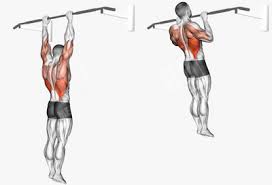
Pull-Ups – Muscles Worked
Primary muscles:
- Latissimus dorsi — the main driver of back width, working hard through the entire range of motion
- Teres major — assists the lats throughout the pulling movement
Secondary muscles:
- Rhomboids — squeezed together at the top of each rep
- Trapezius (mid and lower) — stabilizes and retracts the shoulder blades
- Rear deltoids — assist throughout the pull
- Biceps brachii — heavily involved in elbow flexion on every rep
- Core — works continuously to keep your body stable and prevent swinging
How to Perform Pull-Ups
- Grab a pull-up bar with an overhand grip (palms facing away from you), hands slightly wider than shoulder width.
- Hang at full arm extension — this is called a dead hang. Let your shoulder blades spread and your lats stretch fully.
- Before pulling, depress your shoulder blades — pull them down and back slightly. This pre-engages your lats and protects your shoulders.
- Pull yourself upward by driving your elbows down toward your hips. Think about trying to put your elbows in your back pockets.
- Continue pulling until your chin clears the bar — or ideally your chest reaches bar height for a deeper contraction.
- Lower yourself slowly and under control back to the dead hang position — fully extending your arms at the bottom.
- Repeat for your desired reps.
Pro tip: The lowering phase is just as important as the pulling phase. Dropping quickly from the top robs you of half the muscle-building stimulus. Lower yourself for 2–3 seconds on every rep and you’ll progress much faster.
Pull-Ups – Sets & Reps
| Level | Sets | Reps | Rest |
|---|---|---|---|
| Beginner | 2–3 | 1–5 | 90 sec – 2 min |
| Intermediate | 3–4 | 6–10 | 60–90 sec |
| Advanced | 4–5 | 12–15+ | 60 sec |
Can’t do a pull-up yet? See the progressions section below — everyone starts somewhere.
Pull-Ups – Common Mistakes to Avoid
1. Not starting from a dead hang Starting each rep from a partial hang or with bent arms shortens your range of motion and reduces lat activation. Always begin from a full dead hang with arms completely extended.
2. Swinging your body Using momentum to swing yourself up takes the work away from your back and can strain your shoulders. Keep your body as still as possible — if you’re swinging, slow down or reduce your reps.
3. Pulling with your arms instead of your back This is the most common pull-up mistake. Your biceps will naturally want to dominate. Focus on the elbow-to-hip cue — driving your elbows downward — to ensure your lats are doing the majority of the work.
4. Not going high enough Getting your chin barely over the bar is the minimum — but for maximum lat development, aim to pull until your upper chest reaches the bar. The higher you pull, the more your lats contract at the top.
5. Shrugging your shoulders at the top As fatigue kicks in, many people let their shoulders shrug up toward their ears at the top of the movement. Keep your shoulders actively pulled down throughout — even at the top of the rep.
6. Neglecting the dead hang stretch The full stretch at the bottom isn’t just the start of the next rep — it’s where your lats get fully lengthened under load. Rushing through this phase limits your development over time.
Pull-Ups – Progressions for Beginners
Can’t do a full pull-up yet? Here’s how to build up to it:
- Dead hangs — just hang from the bar for time to build grip and shoulder stability
- Scapular pull-ups — from a dead hang, retract and depress your shoulder blades without bending your elbows. Teaches lat engagement from the start
- Resistance band assisted pull-ups — loop a band around the bar and under your knees to reduce the load
- Assisted pull-up machine — counterweighted machine that lets you practice the movement with less than full bodyweight
- Negative pull-ups — jump or step to the top position and lower yourself as slowly as possible. Incredibly effective for building pull-up strength fast
Making Pull-Ups Harder
Once bodyweight pull-ups feel manageable, here’s how to keep progressing:
- Weighted pull-ups — add a weight plate using a dip belt or hold a dumbbell between your feet
- Archer pull-ups — one arm does most of the work while the other assists, a step toward one-arm pull-ups
- L-sit pull-ups — legs held out in front throughout, massively increases core demand
Where Pull-Ups Fit in Your Workout
Pull-ups are a compound movement and should come early in your back session when you’re freshest. They pair exceptionally well with rowing movements — rows build back thickness, pull-ups build back width — giving you complete back development. Many lifters also use pull-ups as a warm-up or as a daily movement practice outside of their main sessions.