
Cable Hammer Curls: How To, Muscles Worked & Common Mistakes
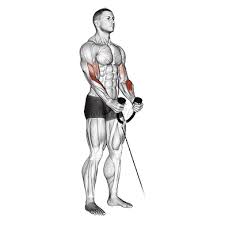
Cable hammer curls combine the best of both worlds — the neutral grip of the hammer curl that targets the brachialis and brachioradialis, with the constant cable tension that keeps your muscles loaded throughout the entire range of motion. It’s one of the most effective exercises for building arm thickness and that full, dense look that regular curls alone can’t fully deliver.
If you’ve been doing dumbbell hammer curls, the cable version is a worthy addition to your rotation — the resistance curve is completely different and challenges your arm muscles in a way dumbbells simply can’t replicate.
How the Cable Hammer Curls Differs from Dumbbell Hammer Curls
Both exercises use a neutral grip and target the same muscles, but the cable changes the resistance profile significantly:
- Dumbbell hammer curls — gravity-based, tension is minimal at the bottom and peaks at parallel. Simple, accessible, great for loading heavy.
- Cable hammer curls — constant horizontal tension from the machine, brachialis and brachioradialis are loaded from the very first degree of movement all the way through to the squeeze at the top.
The rope attachment also allows a unique finishing technique at the top that dumbbells can’t replicate — more on that below.
Cable Hammer Curls – Muscles Worked
Primary muscles:
- Brachialis — the muscle sitting underneath the bicep, heavily targeted by the neutral grip. Well-developed brachialis pushes the bicep upward and adds serious arm thickness.
- Brachioradialis — the large forearm muscle running along the outer forearm, powerfully loaded throughout the neutral grip curl
Secondary muscles:
- Biceps brachii — still significantly involved despite the neutral grip
- Forearm flexors — work to maintain grip on the rope throughout
- Core — stabilizes your torso throughout the standing movement
How to Perform Cable Hammer Curls
- Attach a rope to a low pulley cable machine.
- Stand facing the machine, feet shoulder-width apart. Grip both ends of the rope with a neutral grip — palms facing each other, thumbs pointing up.
- Step back slightly until there’s tension in the cable with your arms fully extended — this is your starting position.
- Keep your elbows pinned to your sides and curl the rope upward toward your shoulders, maintaining the neutral grip throughout.
- As the rope reaches the top — here’s the key technique: pull the two rope ends slightly apart as you squeeze at the peak. This outward pull intensifies the contraction in the brachialis and brachioradialis significantly.
- Slowly lower the rope back to the starting position over 2–3 seconds, resisting the cable on the way down.
- Repeat for your desired reps.
Pro tip: The rope pull-apart at the top is what separates this exercise from a standard cable curl with a bar. Don’t skip it — that extra outward tension at the peak contraction is a big part of what makes the cable rope hammer curl uniquely effective. Even a small pull-apart makes a noticeable difference in how hard your brachialis works.
Cable Hammer Curls – Sets & Reps
| Goal | Sets | Reps | Rest |
|---|---|---|---|
| Muscle building | 3–4 | 10–15 | 60–90 sec |
| Thickness / brachialis focus | 3–4 | 12–15 | 60 sec |
| Pump / finisher | 3 | 15–20 | 45 sec |
Cable Hammer Curls – Common Mistakes to Avoid
1. Letting the rope rotate to a supinated grip The neutral grip is everything with this exercise. If your wrists rotate so your palms face upward during the curl, you’ve shifted from a hammer curl to a standard curl and lost the brachialis emphasis. Keep your thumbs pointing up throughout the entire movement.
2. Skipping the rope pull-apart at the top This is the most unique and valuable part of the cable rope hammer curl. Many people just curl and lower without pulling the rope ends apart. That finishing contraction is worth doing on every single rep — don’t leave it out.
3. Elbows drifting forward Your elbows should stay pinned to your sides throughout the curl. Letting them drift forward brings your shoulders into the movement and reduces brachialis isolation.
4. Standing too close to the machine Same principle as all cable curl variations — standing too close makes the cable angle more vertical, reducing the horizontal tension that loads your muscles at the bottom of the movement. Step back enough to maintain a mostly horizontal cable angle when your arms are extended.
5. Rushing the return Resist the cable slowly on the way back down — 2 to 3 seconds. Letting it snap your arms back removes the eccentric tension that contributes significantly to muscle development.
Where It Fits in Your Workout
Cable hammer curls work well as a secondary or finishing exercise in your biceps or arm session. Because they emphasize the brachialis and brachioradialis rather than the biceps peak, they complement standard bicep curls perfectly — together they give you complete arm development. Many lifters pair cable hammer curls with standing biceps cable curls back to back as a superset to hit the biceps and brachialis with continuous cable tension for a serious arm pump.