
Leg Press: How To, Muscles Worked & Common Mistakes
The leg press is one of the most popular and effective machine exercises for building lower body size and strength. It targets the same primary muscles as the squat — quads, glutes, and hamstrings — but removes the balance, stability, and upper body demands of the barbell squat, letting you focus purely on pushing with your legs.
It’s an excellent complement to squats rather than a replacement for them, and one of the few machine exercises where you can progressively load very heavy over time.
Leg Press – Muscles Worked
Primary muscles:
- Quadriceps — the front of the thigh, the primary driver of the pressing motion
- Glutes — heavily involved, especially at the bottom of the movement
- Hamstrings — assist with hip extension throughout
Secondary muscles:
- Adductors — the inner thigh muscles help stabilize your legs throughout
- Calves — assist as stabilizers throughout the press
The exact emphasis shifts depending on foot placement — more on that below.
How to Perform the Leg Press
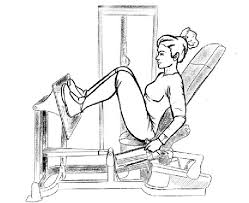
- Sit in the leg press machine and adjust the seat so your knees are at roughly a 90-degree angle when the platform is in the lowered position — not more than 90 degrees.
- Place your feet shoulder-width apart on the platform, roughly in the middle of the footplate. Toes pointed slightly outward.
- Grip the handles at your sides and keep your back and head flat against the seat throughout.
- Release the safety handles and hold the platform with your legs.
- Slowly lower the platform by bending your knees, bringing them toward your chest. Lower until your knees reach roughly a 90-degree angle or slightly past — your lower back should stay flat against the seat at all times.
- Press the platform back up by driving through your entire foot, extending your knees and hips together.
- Stop just short of locking your knees out at the top — keep a very slight bend to maintain tension and protect the joint.
- Repeat for your desired reps. Re-engage the safety handles when done.
Pro tip: Drive through your entire foot — not just your toes or just your heels. Pressing through your toes shifts the load to your knees, pressing through your heels alone reduces quad activation. A full foot press gives you the most balanced muscle engagement.
Leg Press – Sets & Reps
| Goal | Sets | Reps | Rest |
|---|---|---|---|
| Muscle building | 3–4 | 8–12 | 90 sec – 2 min |
| Strength | 4–5 | 5–8 | 2–3 min |
| Endurance / pump | 3 | 15–20 | 60 sec |
Leg Press – Foot Placement Guide
This is one of the most valuable things to understand about the leg press — where you place your feet changes which muscles are emphasized:
- Feet shoulder-width, middle of platform — balanced quad, glute, and hamstring activation. The standard starting position.
- Feet higher on the platform — greater range of hip flexion, more glute and hamstring emphasis, less knee stress
- Feet lower on the platform — greater knee flexion, more quad emphasis, more stress on the knee joint — use carefully
- Feet wider apart — greater inner thigh (adductor) and glute involvement
- Feet closer together — shifts more emphasis to the outer quad (vastus lateralis)
Experimenting with foot placement is a great way to target different areas of your legs without changing exercises.
Leg Press – Common Mistakes to Avoid
1. Lowering too far and losing your lower back This is the most important safety point on the leg press. When you lower the platform too far, your lower back peels off the seat — this is called a “butt wink” on the press and it puts your lumbar spine in a flexed position under load. Stop lowering when your lower back starts to lift from the seat.
2. Locking your knees at the top Snapping your knees to full lockout under load puts significant stress on the knee joint over time. Stop just short of full extension — keep that slight bend to maintain tension and protect your knees.
3. Feet too low on the platform Placing your feet very low increases the knee flexion angle dramatically at the bottom of the movement, putting enormous stress on the knee joint. Keep your feet at mid-platform or higher.
4. Knees caving inward Just like squats, your knees should track in line with your toes throughout the press. If they’re collapsing inward, the weight is too heavy or your adductors and glutes need more work.
5. Using a partial range of motion with excessive weight Loading up the leg press with enormous weight and only doing quarter presses is one of the most common gym mistakes. A full range of motion with moderate weight builds far more muscle than partial reps with maximum weight.
6. Holding your breath Brace your core on the way down, then exhale as you press the platform up. Holding your breath throughout the set can cause a dangerous spike in blood pressure on heavy sets.
Leg Press vs. Barbell Squat
Both exercises build impressive lower body strength and size but they each have their place:
- Barbell squat — free weight, greater overall muscle activation including core and upper back, more functional carry-over, harder to learn
- Leg press — machine-based, removes balance and stability demands, easier to isolate the legs specifically, excellent for high volume and for people with upper body limitations
The leg press doesn’t replace the squat — it complements it. Many serious lifters use both in the same leg session: squats first as the primary compound movement, leg press afterward for additional volume.
Where It Fits in Your Workout
The leg press is a compound machine movement and works best early in your leg session — after barbell squats if you’re doing both, or as your primary leg exercise if squats aren’t part of your program. Follow it with isolation exercises like leg extensions, leg curls, and calf raises for complete leg development.