
Barbell Squats: How To, Muscles Worked & Common Mistakes
The barbell squat is the king of all exercises — and that’s not an exaggeration. No other single movement builds as much total lower body mass, strength, and power as the squat. It’s a true full-body compound exercise that challenges your quads, hamstrings, glutes, lower back, and core simultaneously, and it’s been the foundation of serious strength and muscle building programs since the beginning of the sport.
If you only do one leg exercise, make it this one.
Barbell Squats – Muscles Worked
Primary muscles:
- Quadriceps — the four muscles on the front of your thigh do the bulk of the work, extending your knee on every rep
- Glutes — powerfully engaged at the bottom of the squat and throughout the drive back to standing
- Hamstrings — work to stabilize the knee and assist with hip extension
Secondary muscles:
- Erector spinae — work hard throughout to keep your torso upright and your spine neutral under the bar
- Adductors — the inner thigh muscles help stabilize your hips throughout the squat
- Core — braces to protect your spine and transfer force between your lower and upper body
- Calves — work as stabilizers throughout the movement
- Upper back and traps — hold the bar in position on your back throughout every rep
How to Perform Barbell Squats
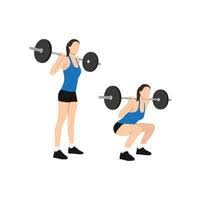
- Set the barbell in a squat rack at about upper chest height. Step under the bar and position it across your upper traps — just below your neck, resting on the meaty part of your traps. This is the high bar position.
- Grip the bar just outside your shoulders, squeeze your shoulder blades together, and create a tight shelf with your upper back for the bar to sit on.
- Unrack the bar by standing up, take two steps back, and stand with your feet shoulder-width apart or slightly wider, toes pointed out at roughly 15–30 degrees.
- Take a deep breath into your belly and brace your core hard — this is the Valsalva maneuver and it protects your spine under load.
- Initiate the squat by pushing your knees out in the direction of your toes while simultaneously pushing your hips back and down.
- Lower yourself until your thighs are at least parallel to the floor — below parallel is even better if your mobility allows.
- Drive back up by pushing the floor away with your feet, keeping your chest up and your knees tracking over your toes throughout the ascent.
- Exhale as you pass the hardest point of the lift on the way up.
- Lock out at the top — hips fully extended, standing tall.
- Repeat for your desired reps.
Barbell Squats Pro tip: Think about “spreading the floor” with your feet as you squat — as if you’re trying to push the ground apart beneath you. This external rotation cue activates your glutes and keeps your knees tracking properly outward over your toes throughout the entire movement.
Barbell Squats – Sets & Reps
| Goal | Sets | Reps | Rest |
|---|---|---|---|
| Muscle building | 3–4 | 6–12 | 2–3 min |
| Strength | 4–5 | 3–5 | 3–5 min |
| Endurance | 3 | 15–20 | 90 sec |
Barbell Squats – Common Mistakes to Avoid
1. Knees caving inward This is one of the most common and most dangerous squat mistakes. When the knees collapse inward during the squat it puts enormous stress on the knee joint over time. Focus on pushing your knees outward in the direction of your toes throughout — the “spread the floor” cue helps enormously.
2. Heels rising off the floor If your heels come up as you squat, your ankles lack the mobility to allow a full depth squat. Work on ankle mobility with stretches and use heel elevation temporarily while you build it. Never squat on your toes — it places the knees in a vulnerable position.
3. Rounding your lower back at the bottom Also known as “butt wink” — when your lower back rounds under as you reach the bottom of the squat. A small amount is normal but excessive rounding under load is a recipe for lower back injury. Improve your hip flexibility and squat only to the depth you can maintain a neutral spine.
4. Chest falling forward If your torso collapses forward as you squat, your upper back and core aren’t braced properly — or your ankle mobility is limiting your depth. Keep your chest up throughout by bracing hard before every rep and driving your elbows down and back.
5. Squatting too high Partial squats — stopping well above parallel — dramatically reduce muscle activation in the glutes and hamstrings and put more stress on the knee joint, not less. Squat to at least parallel for full lower body development.
6. Bar too high on the neck The bar should rest on your upper traps, not on your neck vertebrae. A bar sitting directly on your neck is both painful and dangerous. Build a solid muscle shelf with your shoulder blades before unracking.
High Bar vs. Low Bar
The two most common squat variations differ in bar placement:
- High bar — bar on the upper traps, more upright torso, greater quad emphasis, more natural for most beginners and bodybuilders
- Low bar — bar sits lower on the rear delts, greater forward lean, more hip and posterior chain involvement, preferred by many powerlifters for maximum weight
Both are excellent — high bar is the standard starting point for most people and what we’ve covered here.
Barbell Squats – Depth Guide
Squat depth matters more than most people think:
- Quarter squat — minimal muscle activation, not recommended
- Half squat — acceptable for very heavy strength work but not ideal for muscle building
- Parallel — thighs parallel to the floor, the minimum for full quad and glute activation
- Below parallel / ATG (ass to grass) — maximum range of motion, greatest glute and hamstring involvement, requires good mobility
Aim for parallel as a minimum and work toward below parallel as your mobility improves.
Barbell Squats – Variations
The barbell back squat is the foundation but you have other leg exercises on your site that complement it:
- Leg Press — machine-based alternative that removes the balance and upper body demand.
- Dumbbell Lunges — unilateral variation that addresses strength imbalances.
Where It Fits in Your Workout
The barbell squat is the most demanding exercise in your leg session and should always come first when you’re completely fresh — both physically and neurologically. Never squat at the end of a session when your stabilizers and core are already fatigued. Build your entire leg day around it and follow with isolation work like leg extensions, leg curls, and calf raises afterward.