
Barbell Triceps Extension: How To, Muscles Worked & Common Mistakes
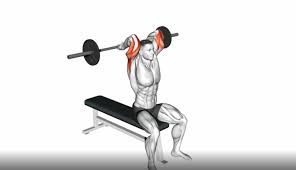
The barbell triceps extension — also known as the overhead triceps extension — is one of the most effective exercises for targeting the long head of the triceps. What makes the overhead position special is that raising your arms above your head fully stretches the long head of the triceps, which is the largest of the three heads and the one most responsible for the overall size of your arms. No other position loads the long head through as great a range of motion.
If you want thick, full-looking triceps from every angle, overhead triceps work is non-negotiable — and the barbell version lets you load up progressively over time.
How the Barbell Triceps Extension Differs from Skull Crushers
Both exercises are barbell triceps movements but the body position changes the stimulus significantly:
- EZ-Bar Skull crushers — lying on a bench, arms angled slightly behind vertical, excellent for loading heavy, strong lateral and medial head involvement
- Barbell triceps extension — standing or seated overhead, arms fully vertical, maximum long head stretch due to the overhead position, slightly less total load but greater long head emphasis
Together these two exercises give your triceps a very complete workout — skull crushers for overall mass and the ability to go heavy, overhead extensions for maximum long head development.
Barbell Triceps Extension – Muscles Worked
Primary muscles:
- Triceps brachii (long head) — placed under maximum stretch with arms overhead, more heavily loaded here than in any other triceps exercise
- Triceps brachii (lateral head) — heavily involved throughout the extension
- Triceps brachii (medial head) — assists throughout the movement
Secondary muscles:
- Core and lower back — work hard to keep your torso upright and stable under the overhead load
- Shoulders — act as stabilizers to maintain the overhead arm position throughout
How to Perform the Barbell Triceps Extension
Standing version:
- Stand with your feet shoulder-width apart. Grip the barbell with a narrow overhand grip, hands about 6–8 inches apart.
- Press the bar overhead until your arms are fully extended directly above your head — this is your starting position.
- Keep your upper arms completely still and pointing straight up throughout. Only your forearms should move.
- Slowly lower the bar behind your head by bending your elbows, feeling a deep stretch in the long head of the triceps.
- Lower until your forearms are roughly parallel to the floor or slightly below — a good stretch is the goal, not maximum depth at the expense of elbow joint comfort.
- Extend your elbows to press the bar back to the starting position, squeezing your triceps hard at lockout.
- Repeat for your desired reps.
Seated version: Same movement performed seated on a bench — slightly more stable and easier to maintain form, which is recommended for beginners or when going heavier.
Barbell Triceps Extension Pro tip: Keep your core braced and avoid arching your lower back as you lower the bar. As the bar descends behind your head it creates a significant forward pull on your torso — a tight core prevents this from turning into lower back stress.
Barbell Triceps Extension – Sets & Reps
| Goal | Sets | Reps | Rest |
|---|---|---|---|
| Muscle building | 3–4 | 8–12 | 90 sec – 2 min |
| Strength | 4–5 | 5–8 | 2–3 min |
| Endurance | 3 | 12–15 | 60 sec |
Barbell Triceps Extension – Common Mistakes to Avoid
1. Upper arms moving during the exercise This is the most important cue — the same as skull crushers. Your upper arms should point straight up and stay completely still throughout every rep. If they’re swinging forward and backward as you extend, you’ve lost the triceps isolation and your shoulders are compensating.
2. Excessive lower back arch As the bar travels behind your head it naturally wants to pull your torso forward. Arching your lower back to compensate puts significant spinal stress over time. Keep your core braced tight and your ribcage down throughout.
3. Elbows flaring outward Your elbows should track forward, pointing toward the ceiling throughout the movement. Letting them flare wide reduces long head activation and stresses the elbow joints. Keep them narrow and pointing straight up.
4. Going too heavy The overhead position makes this exercise significantly more demanding on the elbow joints than lying variations. Too much weight leads to upper arm movement, elbow flare, and lower back compensation. Use a weight that allows strict form throughout every rep.
5. Lowering too far Going excessively deep behind your head doesn’t increase the stretch meaningfully but does put the elbow joint in a vulnerable position. Lower until you feel a solid stretch in the long head — for most people this is around forearms parallel to the floor — and reverse there.
Standing vs. Seated
Both versions are effective but each has advantages:
- Standing — greater core demand, more functional, burns slightly more calories, but harder to maintain strict form as weight increases
- Seated — more stable, easier to maintain upper arm position, recommended when going heavier or when lower back fatigue is a concern
For beginners, seated is a safer starting point. More advanced lifters can use either depending on what they’re training for.
Where It Fits in Your Workout
The barbell triceps extension is a compound triceps movement and works best early in your triceps session after any pressing work but before lighter isolation exercises like triceps pushdowns and triceps kickbacks. Because of the overhead position and the greater long head emphasis, it complements skull crushers perfectly — many lifters use both in the same session, one after the other, for complete triceps development.