

Tricep kickbacks: How To, Muscles Worked & Common Mistakes
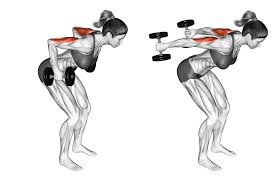
Tricep kickbacks are one of the best finishing exercises for the triceps — and they’re more effective than many people give them credit for. When done correctly with a full extension and a genuine squeeze at the top, the kickback places your triceps in a maximally contracted position at the peak of every rep. That hard contraction at the end range is what makes kickbacks uniquely valuable as a finishing exercise after your heavier triceps work.
The key word there is “finishing.” Kickbacks aren’t the exercise to go heavy on — they’re the exercise to go precise on.
Tricep Kickbacks – Muscles Worked
Primary muscles:
- Triceps brachii (lateral head) — the outer triceps head, placed in a strongly contracted position at the top of the kickback
- Triceps brachii (medial head) — heavily involved throughout the extension
- Triceps brachii (long head) — involved throughout, though less stretched here than in overhead variations
Secondary muscles:
- Rear deltoids — work as stabilizers to maintain the upper arm position throughout
- Core and erector spinae — work to maintain the hinged torso position throughout the set
How to Perform Tricep Kickbacks
- Hold a dumbbell in one hand and place your opposite knee and hand on a flat bench for support — the same setup as a dumbbell row.
- Keep your back flat and roughly parallel to the floor. Pick up the dumbbell with your working arm and bring your upper arm up so it’s parallel to the floor and tucked close to your side — elbow bent at 90 degrees. This is your starting position.
- Keeping your upper arm completely still and parallel to the floor, extend your forearm backward by straightening your elbow until your entire arm is fully extended and parallel to the floor.
- At full extension, squeeze your tricep as hard as possible and hold for a brief moment — this peak contraction is the most important part of the exercise.
- Slowly return your forearm to the 90-degree starting position over 2–3 seconds.
- Complete all reps on one side, then switch.
Tricep Kickbacks Pro tip: At the very top of the movement when your arm is fully extended, try rotating your wrist slightly so your pinky faces the ceiling. This small external rotation intensifies the lateral head contraction significantly — the same principle as the supination cue in curls, applied in reverse for the triceps.
Tricep Kickbacks – Sets & Reps
| Goal | Sets | Reps | Rest |
|---|---|---|---|
| Muscle building | 3–4 | 12–15 per side | 60 sec |
| Definition / pump | 3–4 | 15–20 per side | 45 sec |
| Finishing burnout | 2–3 | 20+ per side | Minimal |
Tricep Kickbacks – Common Mistakes to Avoid
1. Upper arm dropping below parallel Your upper arm must stay parallel to the floor throughout every rep — this is the most important setup cue. If your elbow drops below your back, the resistance profile changes and your triceps lose the tension at the top of the movement. Keep that upper arm locked parallel to the floor.
2. Going too heavy This is the number one mistake with kickbacks. Heavy weight causes your upper arm to drop, your torso to rotate, and the dumbbell to swing rather than extend smoothly. The triceps aren’t in a mechanically strong position during kickbacks — use a light to moderate weight and focus entirely on the squeeze at the top.
3. Not fully extending at the top Stopping short of full arm extension means you never reach the maximally contracted position — which is the whole point of the exercise. Extend completely until your arm is straight and squeeze hard before returning.
4. Swinging the dumbbell Using momentum to swing the dumbbell back rather than extending it with triceps strength defeats the purpose entirely. Keep the movement slow, deliberate, and fully controlled in both directions.
5. Torso not parallel to the floor If you’re standing too upright with just a slight forward lean, the angle of resistance works against you and reduces triceps activation significantly. Get your torso close to parallel to the floor — the more horizontal, the better the resistance curve for the kickback.
Tricep Kickbacks – Variation
The dumbbell kickback we’ve covered above loses tension at the bottom of the movement where your arm is at 90 degrees. For constant tension throughout, attach a single handle to a low pulley and perform the same kickback motion — the cable keeps your tricep loaded even at the starting position. This is a great variation to rotate in for a different stimulus.
Where It Fits in Your Workout
Tricep kickbacks are a finishing isolation exercise and belong at the very end of your triceps session — after all your heavier compound work like triceps pushdowns, skull crushers, and overhead extensions. By the time you get to kickbacks your triceps should already be pumped and fatigued, and the strict isolation and peak contraction of the kickback squeezes out every last bit of effort from those muscles before you’re done.