

Front Plate Raise: How To, Muscles Worked & Common Mistakes
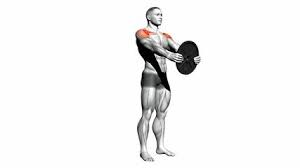
The front plate raise targets the same muscle as the front dumbbell raise and front cable raise — the anterior deltoid — but using a weight plate instead of dumbbells changes the exercise in a few practical ways that make it a worthwhile variation to include in your training.
The biggest difference is grip. Holding a plate with both hands naturally puts your wrists in a neutral, comfortable position and forces both shoulders to work simultaneously and equally. It also feels more stable in the hands for many people, making it a great option when you want a simple, clean movement with minimal setup.
How the Front Plate Raise Differs from the Other Front Raise Variations
All three front raise variations on your site target the anterior deltoid but each has its own feel:
- Front dumbbell raise — most versatile, can alternate or do both arms simultaneously, full control over each arm independently.
- Front cable raise — constant cable tension from the very bottom of the movement, best for time under tension.
- Front plate raise (this page) — both hands on a single plate, naturally neutral grip, both shoulders working together, simple and no equipment setup needed beyond a plate
Front Plate Raise – Muscles Worked
Primary muscles:
- Anterior deltoid — the front head of the shoulder, the primary target throughout the raise
Secondary muscles:
- Lateral deltoid — assists slightly as the plate rises
- Clavicular head of pectoralis major — the upper chest contributes at the start of the lift
- Serratus anterior — stabilizes the shoulder blade throughout
- Forearms and grip — work to hold the plate securely throughout the set
- Core — braces to keep your torso upright and prevent leaning back
How to Perform the Front Plate Raise
- Stand with your feet shoulder-width apart and hold a weight plate with both hands at roughly the 3 and 9 o’clock positions on the edge — or grip the sides of the plate with your fingers.
- Let the plate hang in front of your thighs, arms nearly straight with a soft bend in the elbows.
- Raise the plate straight forward and upward in a smooth arc, keeping your arms in line with your shoulders.
- Raise until the plate is parallel to the floor and your arms are straight out in front of you.
- Hold briefly at the top and squeeze your anterior delts.
- Slowly lower the plate back to the starting position over 2–3 seconds.
- Repeat for your desired reps.
Pro tip: Keep your grip on the outer edges of the plate rather than gripping through the center hole. Gripping the edges keeps your wrists neutral and your forearms more relaxed, letting your shoulders do the work rather than your grip fighting to hold the plate steady.
Front Plate Raise – Sets & Reps
| Goal | Sets | Reps | Rest |
|---|---|---|---|
| Muscle building | 3–4 | 10–15 | 60 sec |
| Definition / pump | 3 | 15–20 | 45 sec |
| Superset finisher | 2–3 | 15–20 | Minimal |
Front Plate Raise – Common Mistakes to Avoid
1. Using too heavy a plate Because you’re holding the plate at the end of both arms as a fixed object, even a modest weight creates a significant lever arm. Start lighter than you think you need to — a 10kg plate is often more than enough for most people when done with strict form.
2. Swinging the plate with momentum The plate’s shape and weight make it easy to use a little body sway to get it moving. Keep your torso completely still and raise with strict shoulder control — your core should be braced throughout.
3. Raising too high Parallel to the floor is your target. Lifting higher shifts the stress to the shoulder joint rather than keeping it on the anterior delt. Stop at parallel and squeeze before lowering.
4. Locking your elbows Keep a soft, consistent bend throughout. Locking out shifts the mechanical stress onto the elbow joint and away from the shoulder.
5. Lowering too quickly The slow lowering phase is where eccentric tension builds muscle. Lower the plate deliberately over 2–3 seconds rather than letting it drop — you’ll feel the difference in your anterior delts immediately.
Where It Fits in Your Workout
The front plate raise is an isolation exercise and belongs toward the end of your shoulder session after compound pressing work. Like all front raise variations, the anterior deltoid is already well-worked by pressing exercises so 2–3 sets is typically enough. It works well as a simple finisher when the cable machine is occupied or when you want a change of pace from dumbbells. Pair it with side lateral raises for a complete anterior and lateral delt finishing circuit.