Alternate Hammer Curl: How To, Muscles Worked & Common Mistakes
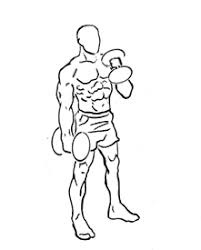
The alternate hammer curl is one of the best exercises for building overall arm thickness — and it often gets overshadowed by traditional bicep curls even though it targets muscles that regular curls miss. The neutral grip (palms facing each other, like holding a hammer) shifts significant emphasis to the brachialis and brachioradialis, which sit underneath and alongside the biceps and are responsible for a lot of that thick, full arm look.
If you want bigger arms that look impressive from every angle, not just the front, hammer curls need to be in your routine.
How the Alternate Hammer Curl Differs from Regular Curls
The key difference is the grip:
- Standard curl — underhand grip (palms up), maximizes biceps brachii activation, particularly the long head
- Hammer curl — neutral grip (palms facing each other), shifts more emphasis to the brachialis and brachioradialis while still working the biceps, and is much more comfortable on the wrists for most people
The brachialis sits underneath the bicep — when it’s developed, it pushes the bicep upward and makes your arms look significantly thicker and more impressive. Check out our Dumbbell Curls page for the standard supinated version.
Alternate Hammer Curl – Muscles Worked
Primary muscles:
- Brachialis — the primary target of the neutral grip, sits underneath the bicep and adds serious thickness to the upper arm
- Brachioradialis — the large forearm muscle running along the outside of the arm, heavily loaded with a neutral grip
- Biceps brachii — still significantly involved despite the grip change
Secondary muscles:
- Forearm flexors — work to maintain the neutral grip throughout
- Core — stabilizes your torso throughout the standing movement
How to Perform the Alternate Hammer Curl
- Stand with your feet shoulder-width apart, a dumbbell in each hand. Hold the dumbbells with a neutral grip — palms facing your body, thumbs pointing forward. This is the hammer position.
- Let both dumbbells hang at your sides, arms fully extended — starting position.
- Keep your elbow pinned close to your side and curl one dumbbell upward, maintaining the neutral grip throughout — the dumbbell stays vertical like a hammer the entire time, it does not rotate.
- Curl until your forearm is roughly vertical and squeeze at the top.
- Slowly lower the dumbbell back down under control over 2–3 seconds.
- Repeat with the opposite arm — this is one complete rep.
- Continue alternating for your desired number of reps.
Alternate Hammer Curl Pro tip: Focus on keeping the dumbbell perfectly vertical throughout the entire movement — thumb pointing up at the bottom, thumb pointing toward your shoulder at the top. The moment it starts to rotate toward a supinated position, you’ve shifted back into a standard curl. Keep it neutral the whole way through.
Alternate Hammer Curl – Sets & Reps
| Goal | Sets | Reps | Rest |
|---|---|---|---|
| Muscle building | 3–4 | 10–15 per side | 60–90 sec |
| Strength | 4 | 6–8 per side | 2 min |
| Endurance / pump | 3 | 15–20 per side | 45 sec |
Alternate Hammer Curl – Common Mistakes to Avoid
1. Rotating the wrist at the top The whole point of the hammer curl is the neutral grip. If your wrist rotates to a supinated position as you approach the top of the curl, you’re essentially turning it into a regular dumbbell curl. Keep the dumbbell vertical throughout every rep.
2. Swinging with momentum Same as any standing curl — swinging your torso to help swing the weight up removes the load from your arm muscles. Keep your torso still and curl with strict muscle control.
3. Upper arm drifting forward Your elbow should act as a fixed pivot point pinned to your side. If your upper arm swings forward as you curl, you’re using your shoulder to assist. Pin the elbow and keep it there.
4. Alternating too fast Because you’re alternating arms there’s a temptation to rush through reps to get them done. Slow down — give each arm the same focus and control as you would if you were doing a full set with one arm.
5. Not fully extending at the bottom Let your arm fully extend before starting the next rep. Cutting the range of motion short at the bottom reduces the stretch on the brachialis and limits the effectiveness of the exercise.
Alternating vs. Simultaneous
You can do hammer curls alternating one arm at a time or both simultaneously:
- Alternating — what we’ve covered here. Lets you focus more on each arm individually, gives a brief rest between reps, better for mind-muscle connection
- Simultaneous — both arms curl at the same time, more intense, shorter set time
Both work well — alternating is generally recommended for better isolation and focus on each arm.
Alternate Hammer Curl – Variation
For constant tension throughout the full range of motion, check out our Cable Hammer Curl page — the rope attachment on a low pulley cable delivers the same neutral grip movement with cable tension that loads the brachialis from the very bottom of the movement.
Where It Fits in Your Workout
The alternate hammer curl works well as a secondary biceps exercise after your primary curling work like barbell curls or dumbbell curls. Because it emphasizes the brachialis and brachioradialis rather than just the biceps, it complements standard curls perfectly — together they give you complete arm development from multiple angles.