

Standing Biceps Cable Curl: How To, Muscles Worked & Common Mistakes
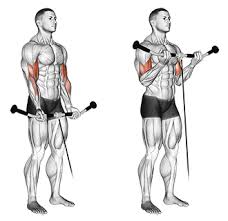
The standing biceps cable curl is the cable machine equivalent of the barbell curl — and the cable makes a meaningful difference. While a barbell provides gravity-based resistance that drops off at the top and bottom of the movement, the cable machine keeps constant tension on your biceps throughout the entire range of motion. That means your muscles are working hard from the very first degree of the curl all the way to the squeeze at the top.
It’s one of the best biceps exercises to pair with free weight curls for complete bicep development.
Why Cable Tension Matters for Biceps
This is the key advantage over barbell and dumbbell curls:
- Barbell/dumbbell curls — gravity-based resistance, tension peaks at parallel and is minimal at the very top and bottom of the movement
- Cable curl — horizontal resistance from behind, your biceps are loaded throughout the full arc including at the bottom where dumbbells provide almost nothing
This constant tension means more total time under load per rep, which translates to a better pump and more muscle stimulus across the full range of motion. Check out our Barbell Curl page for the free weight version.
Standing Biceps Cable Curl – Muscles Worked
Primary muscles:
- Biceps brachii — the main target, worked with constant tension through the full range of motion
- Brachialis — heavily involved throughout, adds thickness underneath the bicep
Secondary muscles:
- Brachioradialis — forearm muscle that assists with the curl
- Forearm flexors — work to maintain the underhand grip throughout
- Core — stabilizes your torso throughout the standing movement
How to Perform the Standing Biceps Cable Curl
- Attach a straight bar or EZ curl bar to a low pulley cable machine.
- Stand facing the machine, feet shoulder-width apart, and grip the bar with an underhand grip (palms facing up), hands about shoulder-width apart.
- Step back slightly so there’s tension in the cable before you even start — your arms should be fully extended and the cable taut at the starting position.
- Keep your elbows pinned to your sides throughout — they are the fixed pivot point of the movement.
- Curl the bar upward toward your shoulders in a smooth arc, exhaling as you lift.
- Squeeze your biceps hard at the top — hold briefly.
- Slowly lower the bar back to the starting position over 2–3 seconds, resisting the cable on the way down.
- Repeat for your desired reps.
Standing Biceps Cable Curl Pro tip: Stand slightly further from the machine than feels natural. The further you stand, the more horizontal the cable angle at the bottom — which maximizes the tension on your biceps right from the start of the curl where free weights provide the least resistance.
Standing Biceps Cable Curl – Sets & Reps
| Goal | Sets | Reps | Rest |
|---|---|---|---|
| Muscle building | 3–4 | 10–15 | 60–90 sec |
| Strength | 4 | 6–8 | 90 sec – 2 min |
| Pump / finisher | 3 | 15–20 | 45 sec |
Standing Biceps Cable Curl – Common Mistakes to Avoid
1. Standing too close to the machine If you’re right next to the machine, the cable pulls more vertically than horizontally — similar to a dumbbell curl and you lose the constant tension advantage. Step back enough that the cable angle is mostly horizontal when your arms are extended.
2. Elbows drifting forward Just like barbell curls, your elbows should stay pinned to your sides throughout. Letting them drift forward as you curl reduces range of motion and brings your shoulders into the movement.
3. Using momentum The cable makes it easy to use a quick body sway to get the bar moving. Keep your torso completely still and curl with strict muscle control — the cable will still feel challenging with proper form.
4. Letting the cable pull your arms back too fast The slow return against the cable is where a lot of the bicep stimulus comes from. Resist the cable deliberately on the way down over 2–3 seconds rather than letting it snap your arms back to the start.
5. Grip too wide or too narrow Shoulder-width grip is the neutral sweet spot. Too wide shifts more work to the short head, too narrow shifts more to the long head — neither is wrong intentionally, but shoulder-width works both heads evenly for general development.
Standing Biceps Cable Curl – Attachment Options
The straight bar is the standard but you have other options:
- Straight bar — fully supinated grip, maximum bicep activation, can cause wrist discomfort for some
- EZ curl bar attachment — angled grip, more comfortable on wrists and elbows, slightly less supination but still very effective
- Rope attachment — allows your wrists to rotate naturally throughout the curl, also useful for hammer curl variations
Standing Biceps Cable Curl – Variations
You have two other cable curl variations on your site that hit the biceps from different angles:
- Overhead Cable Curl — arms extended overhead, targets the long head through a unique stretched position.
- Low Pulley Bicep Cable Curl — single arm variation with a slightly different setup.
Where It Fits in Your Workout
The standing biceps cable curl works well as a secondary biceps exercise after your heavier free weight work like barbell or dumbbell curls. Many lifters finish their bicep session with cable curls specifically for the pump and constant tension — it’s an excellent way to maximize the total time under load before ending the workout. It also pairs well in a superset with tricep pushdowns for an efficient arm superset.