

Tricep kickbacks: How To, Muscles Worked & Common Mistakes
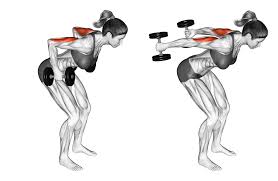
Table of Contents
Tricep kickbacks are one of the best finishing exercises for the triceps — and they’re more effective than many people give them credit for. With a dumbbell, the resistance is greatest at the top of each rep, when your arm is fully extended, so a full extension and a genuine squeeze put your triceps under the most load exactly where they’re fully contracted. That hard squeeze at the end of the movement is what makes kickbacks so valuable as a finisher after your heavier triceps work.
The key word there is “finishing.” Kickbacks aren’t the exercise to go heavy on — they’re the exercise to be precise on.
Tricep Kickbacks – Muscles Worked
Primary muscles:
- Triceps brachii (lateral head) — the outer triceps head, working hard into the fully contracted position at the top of the kickback
- Triceps brachii (medial head) — heavily involved throughout the extension
- Triceps brachii (long head) — involved throughout, though it’s far less stretched here than in overhead exercises
Secondary muscles:
- Rear deltoids — work as stabilizers to hold your upper arm in position throughout
- Core and erector spinae — work to hold the hinged torso position throughout the set
How to Perform Tricep Kickbacks
- Hold a dumbbell in one hand and place your opposite knee and hand on a flat bench for support — the same setup as a dumbbell row.
- Keep your back flat and roughly parallel to the floor. Bring your working upper arm up so it’s parallel to the floor and tucked close to your side, with your elbow bent at 90 degrees. This is your starting position.
- Keeping your upper arm still and parallel to the floor, extend your forearm backward by straightening your elbow until your whole arm is fully extended and parallel to the floor.
- At full extension, squeeze your triceps as hard as you can and hold for a brief moment — this is the most valuable part of the exercise.
- Slowly return your forearm to the 90-degree starting position over 2–3 seconds.
- Complete all your reps on one side, then switch.
Tricep Kickbacks Pro tip: Hold the squeeze at full extension for a full second on every rep, and keep an eye on your upper arm — as you tire, it tends to creep down toward the floor, which takes tension off your triceps at the top. If you can’t hold your arm in line with your body for the full squeeze, the weight is too heavy.
Tricep Kickbacks – Sets & Reps
| Goal | Sets | Reps | Rest |
|---|---|---|---|
| Muscle building | 3–4 | 12–15 per side | 60 sec |
| Higher reps | 3–4 | 15–20 per side | 45 sec |
| Finishing burnout | 2–3 | 20+ per side | Minimal |
Tricep Kickbacks – Common Mistakes to Avoid
1. Upper arm dropping below parallel Your upper arm should stay parallel to the floor on every rep — this is the most important setup cue. If your elbow drops below your back, the resistance changes and your triceps lose tension at the top of the movement. Keep your upper arm locked parallel to the floor.
2. Going too heavy This is the number one mistake with kickbacks. Heavy weight causes your upper arm to drop, your torso to rotate, and the dumbbell to swing rather than extend smoothly. Because the resistance is greatest at full extension, kickbacks feel heavy even with light dumbbells — use a light to moderate weight and focus on the squeeze at the top.
3. Not fully extending at the top Stopping short of full extension means you never reach the fully contracted position — a big part of what makes this exercise worthwhile. Extend completely until your arm is straight, and squeeze hard before returning.
4. Swinging the dumbbell Using momentum to swing the dumbbell back, rather than extending it with your triceps, takes much of the work away from the muscle you’re trying to train. Keep the movement slow, deliberate, and fully controlled in both directions.
5. Torso not parallel to the floor If you’re standing too upright, with just a slight forward lean, gravity no longer loads the movement the way it should, and the exercise becomes much less effective. Get your torso close to parallel to the floor — the more horizontal, the better the resistance curve for the kickback.
Tricep Kickbacks – Variation
The dumbbell kickback covered above loses tension at the bottom of the movement, when your forearm hangs straight down at 90 degrees. For tension right from the start, attach a single handle to a low pulley and perform the same kickback motion — the cable keeps your triceps loaded even in the starting position. It’s a great variation to rotate in for a different stimulus.
Where It Fits in Your Workout
Tricep kickbacks are a finishing isolation exercise and belong at the very end of your triceps session — after your heavier triceps work, like triceps pushdowns, skull crushers, and overhead extensions. By the time you get to kickbacks, your triceps should already be pumped and fatigued, and the strict isolation and hard squeeze of the kickback squeeze out the last of your effort before you’re done. For a complete plan, see our guide to the best triceps exercises.