

Chakras and the Nervous System: What’s Actually Happening
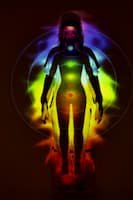
Table of Contents
Chakras are one of the best-known ideas to come out of yoga: a column of energy centers running from the base of the spine to the crown of the head, each linked to a part of the body and a part of human experience. Plenty of people work with them in meditation and yoga, and plenty of others wonder whether there’s anything to them at all.
The honest answer is more interesting than either side usually allows. There’s no evidence that chakras exist as physical structures or as a separate kind of energy. But the places they mark aren’t random. Several sit where people consistently feel emotions, along the path of one of the body’s most important nerves, and the practices built around them change the nervous system in ways researchers can measure.
Here we look at where chakras come from, what’s happening in the body at those points, what chakra practices actually do, and where the claims go further than the evidence.
What Are Chakras?
Chakra (cakra in Sanskrit) means “wheel” or “circle.” The idea comes from the tantric traditions of medieval India, which shaped both Hindu and Buddhist practice. There, chakras were part of the subtle body, a map of centers and channels (called nadis) that practitioners worked with through visualization, mantra, breath and posture. In some schools, a power called kundalini, pictured as a serpent coiled at the base of the spine, was said to rise through the chakras during advanced practice.
Many scholars read these systems less as descriptions of anatomy and more as instructions for meditation. A practitioner might be told to picture a lotus with a set number of petals at a point in the body, place a specific syllable there and hold their attention on it. The subtle body was something you worked with from the inside, not something you’d expect to find in an anatomy textbook.
Seven Chakras, or More?
The system most people know has seven chakras. It comes largely from a 16th-century Sanskrit text, the Sat-Cakra-Nirupana (“Description of the Six Centers”), attributed to a Bengali teacher named Purnananda. It describes six centers along the spine plus a seventh at the crown of the head. Other texts give different numbers. Some Buddhist systems center on four, while some Hindu texts list more than seven.
The seven-chakra system reached the West mainly through The Serpent Power, a 1919 translation of that text by John Woodroffe, a British judge in India who wrote under the name Arthur Avalon. Much of what’s taught about chakras today came later. Theosophists such as C.W. Leadbeater, whose book The Chakras appeared in 1927, helped popularize them, and Western writers went on to link the chakras to nerve centers and glands, then added the rainbow color scheme and the personality traits now attached to each one. So the “ancient chakra system” as it’s often taught is a blend of Indian sources and 20th-century Western ideas.
The Seven Chakras at a Glance
Here’s the modern seven-chakra system, with what each Sanskrit name means and what’s physically in that part of the body.
| Chakra | Location | Name means | What’s in that area |
|---|---|---|---|
| Muladhara (root) | Base of the spine and pelvic floor | “Root support” | Pelvic floor muscles, sacrum and tailbone |
| Svadhisthana (sacral) | Lower abdomen | “One’s own seat” | Bladder, reproductive organs and lower intestines |
| Manipura (solar plexus) | Navel to upper abdomen | “City of jewels” | Stomach, upper intestines and the celiac plexus, a nerve network also called the solar plexus |
| Anahata (heart) | Center of the chest | “Unstruck” | Heart, lungs and the cardiac nerve plexus |
| Vishuddha (throat) | Throat | “Especially pure” | Larynx, throat muscles and branches of the vagus nerve |
| Ajna (third eye) | Between the eyebrows | “Command” | Forehead and the muscles around the eyes |
| Sahasrara (crown) | Top of the head | “Thousand-petaled” | Scalp and the top of the skull |
In the traditional texts, each center also has its own element, deity, number of lotus petals and seed syllable (bija mantra), such as lam for the root and ham for the throat. The name anahata refers to an “unstruck” sound, one heard in meditation without anything striking anything else.
Why the Chakra Locations Aren’t Random
Several chakras sit where people feel emotions in their bodies. Think of the lump in your throat when you hold back tears, the heavy or warm feeling in your chest with grief or love, and the knot in your stomach before something stressful. These sensations are more than figures of speech.
A 2014 study in the Proceedings of the National Academy of Sciences asked 701 people from Finland, Sweden and Taiwan to color in body outlines to show where they felt activity increase or decrease with different emotions. Each emotion produced its own distinct map, and the maps were consistent across the European and East Asian groups. Most basic emotions showed increased activity in the upper chest, which the researchers linked to changes in breathing and heart rate. The study had nothing to do with chakras, but its maps overlap with several of them.
There’s also a physical reason those spots carry so much feeling. The vagus nerve, the longest of the cranial nerves, runs from the brainstem down through the neck, past the heart and lungs, and into the digestive tract. That’s the same line as the throat, heart and solar plexus chakras. The original texts don’t describe the vagus nerve, so this is a modern observation rather than ancient knowledge, but it helps explain why those areas feel so emotionally charged.
The vagus nerve is part of the autonomic nervous system, which runs the body’s automatic functions, such as heart rate, breathing, digestion and blood flow. “Autonomic” comes from Greek words meaning self-governing, which is why emotional sensations show up whether we want them or not. When you’re anxious, sad or excited, this system shifts your heart rate, breathing, digestion and blood flow, often alongside changes in muscle tension, and you feel those changes where they happen.
What You’re Feeling When You Feel a Chakra
Your sense of what’s happening inside your body is called interoception. Your organs and tissues are full of sensors that track their own state, including stretch receptors in the stomach and lungs and stretch and pressure sensors in the heart and major blood vessels. The vagus nerve is mostly a messenger to the brain: around 80 percent of its fibers carry information up from the organs rather than instructions down to them. In the brain, a region called the insula plays a central role in pulling these signals together into your felt sense of your body.
This is where the language of energy makes some sense. When an emotion tightens your muscles or makes your heart work harder, those tissues burn more fuel and give off more heat. When blood rushes into your skin, as it does in your face when you’re embarrassed, the area warms up. Your sensors pick up those changes. What’s rising is ordinary physical energy rather than a separate kind, but the feeling of something building or flowing in one spot is real.
The brain also interprets these signals rather than just reading them, which is why the same racing heart can feel like fear in one situation and excitement in another.
What Chakra Practices Do to Your Nervous System
Chakra practices tend to draw on four tools: breath, sound, attention and posture. Each one acts on the nervous system.
Breath
Chakra meditations often pair each center with slow breathing and long exhales. Your heart rate naturally rises a little as you breathe in and falls as you breathe out. Slowing your breathing and lengthening the exhale leans into that rhythm, and research on slow breathing links it to higher heart rate variability and a shift toward the calming, parasympathetic side of the nervous system.
Sound
Chanting runs through chakra practice, from the seed syllable for each center to longer mantras, and chanting naturally slows and lengthens the exhale. In a 2001 study published in the BMJ, 23 healthy adults recited both a yoga mantra and the Ave Maria prayer of the rosary in Latin. Both slowed their breathing to around six breaths per minute, and both increased heart rate variability and baroreflex sensitivity, a measure of how well the heart responds to changes in blood pressure. Since a mantra and a Catholic prayer had similar effects, the researchers attributed them to the slower breathing rhythm the two shared.
Attention
Moving your attention through the body, center by center, is a deliberate way of practicing interoception. What that practice changes is still being worked out. Experienced meditators generally haven’t been better than non-meditators at detecting their own heartbeat, and a 2020 analysis pooling data from 724 people found little evidence of a difference. But practice does seem to change how these sensations are experienced. In the same 2020 study, when participants’ heart rate was raised with a drug similar to adrenaline, meditators were more likely to feel it across central parts of the body, including the chest, abdomen, neck, back and head. It’s an intriguing overlap with the chakra map, though the researchers weren’t studying chakras.
Focused attention also tends to make sensations stronger. If you hold your attention on the point between your eyebrows for several minutes, you may notice pressure, tingling, warmth or patterns of light behind your closed eyes. Those experiences are real, and they have ordinary explanations: sustained attention, tension in the muscles around the eyes, and the visual system’s natural activity when your eyes are closed.
Posture
Yoga sequences built around the chakras tend to work the areas where those centers sit: hip and pelvic floor work for the root, backbends and chest openers for the heart, and neck and jaw release for the throat. Releasing tension in an area changes the signals your sensors send from it, which may be part of why a posture can seem to shift your mood.
Where the Evidence Runs Out
No instrument has detected chakras, and there’s no evidence that they exist as physical structures or as a separate form of energy. Claims that “blocked,” “overactive” or “unbalanced” chakras cause physical or emotional problems haven’t been supported by research.
One of the best-known tests of the idea behind those claims, that people have an energy field others can feel, was designed by a nine-year-old. Emily Rosa’s experiment, published in JAMA in 1998, tested 21 practitioners of therapeutic touch, a practice based on sensing and adjusting a “human energy field.” Each practitioner put their hands through a screen so they couldn’t see, and Emily held her hand a few inches above one of them, chosen by a coin flip. Across 280 trials, the practitioners picked the right hand 44 percent of the time, no better than guessing.
Chakra work isn’t a treatment for medical or mental health conditions, and a chakra reading isn’t a substitute for a proper diagnosis. As a practice for calming the body, noticing emotions and building body awareness, it can sit comfortably alongside everything else you do for your health.
Practicing Safely
Gentle chakra meditation with relaxed breathing is low risk for most people. A few things are worth knowing before going further.
- Forceful or rapid breathing techniques, such as kapalabhati and breath of fire, can cause dizziness, tingling and lightheadedness. Do them seated, and don’t practice them in water or while driving. If you’re pregnant or have a heart condition, high blood pressure, epilepsy or a history of panic attacks, check with your doctor first.
- Intensive meditation occasionally brings up difficult experiences, such as anxiety, distressing memories or unusual body sensations. A 2017 study of Western Buddhist meditators documented a wide range of these challenges. If a practice consistently leaves you feeling worse, ease off and talk to an experienced teacher or a mental health professional.
- If you’ve been through trauma, body-focused practices can sometimes stir up strong reactions. A trauma-informed teacher can help you go at a pace that feels safe.
Frequently Asked Questions
Are chakras real?
Not as physical structures or a separate form of energy, as far as the evidence shows. They’re real in a different sense: they mark places where people consistently feel emotions, and the practices built around them have measurable effects on the nervous system.
How many chakras are there?
The modern system has seven, running from the base of the spine to the crown of the head. Traditional texts vary, with some Buddhist systems describing four main centers and some Hindu texts describing more than seven.
What does it mean when a chakra is blocked?
In energy-healing language, a blocked chakra is one where energy isn’t flowing properly, which is said to cause problems linked to that area. There’s no evidence behind that idea. What people describe as a blockage, such as a tight throat or a clenched stomach, often matches ordinary tension and stress responses, which you can work with through breathing, movement and attention.
Why do I feel tingling or warmth when I focus on a chakra?
Focusing on one spot makes you more aware of sensations that are already there, and holding your attention on it can bring on tingling, warmth, pressure or pulsing. Changes in breathing, muscle tension and blood flow during meditation add to the effect. The sensations are real, even though the explanation is physical.
Do you have to believe in chakras for chakra meditation to work?
No. The parts with the clearest evidence, such as slow breathing, long exhales and chanting, act on the nervous system whatever you believe about them. Many people simply find the chakra map a useful way to organize a body-awareness practice.