

Kneeling Cable Crunch: How To, Muscles Worked & Common Mistakes
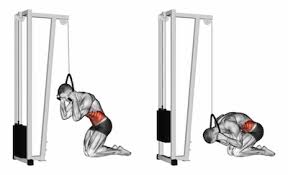
The kneeling cable crunch is the most important ab exercise most people aren’t doing — and here’s why. It’s the only common ab exercise that allows you to progressively increase the resistance over time, just like you would with any other muscle group. You can add weight every few weeks and track your progress. That’s something bodyweight crunches, sit-ups, and floor exercises simply can’t offer in the same way.
If you want to actually build the rectus abdominis as a muscle rather than just training its endurance, the kneeling cable crunch is your best tool.
Why Progressive Overload Matters for Abs
Most people train their abs exclusively with bodyweight exercises — crunches, sit-ups, leg raises. These are great for building endurance and core stability, but the abs are a muscle like any other. To grow and become more defined, they need to be progressively challenged with increasing resistance over time.
The cable machine provides exactly that. You start with a light weight, master the technique, and gradually add more over weeks and months — the same principle you’d apply to your bench press or squat. This is why many serious bodybuilders and physique athletes consider the cable crunch their primary ab exercise.
Kneeling Cable Crunch – Muscles Worked
Primary muscles:
- Rectus abdominis — the “six-pack” muscle, directly targeted through weighted spinal flexion. The cable provides constant tension throughout the full range of motion, loading the abs from the stretched position all the way through to the contraction.
Secondary muscles:
- Obliques — assist with stabilization throughout the movement
- Transverse abdominis — braces to support the spine throughout
- Hip flexors — minimal involvement when the hips remain stationary as instructed
How to Perform the Kneeling Cable Crunch
- Attach a rope handle to a high pulley cable machine. Kneel facing the machine, about an arm’s length away.
- Grab both ends of the rope and bring your hands to the sides of your head — your fists should be near your temples or cheekbones, not pulling on your neck.
- Sit back slightly on your heels and keep your hips stationary in this position throughout — they should not move at all during the exercise.
- Take a breath, then exhale forcefully as you crunch your torso downward — think about bringing your elbows toward your thighs by rounding your spine.
- At the bottom, squeeze your abs as hard as possible and hold briefly — your elbows should be close to or touching your thighs.
- Slowly allow the cable to pull you back to the starting position over 2–3 seconds, feeling your abs stretch under the resistance.
- Repeat for your desired reps.
Kneeling Cable Crunch Pro tip: The movement should come entirely from your spine rounding — not from your hips hinging forward. Many people rock forward from the hips which brings their hip flexors into the movement. Keep your hips completely still on your heels and think about curling your ribcage toward your pelvis — that’s pure abdominal work.
Kneeling Cable Crunch – Sets & Reps
| Goal | Sets | Reps | Rest |
|---|---|---|---|
| Muscle building | 3–4 | 10–15 | 60 sec |
| Strength | 4 | 8–10 | 90 sec |
| Endurance / pump | 3 | 15–20 | 45 sec |
Start with a light weight and focus entirely on feeling the abs work before increasing the load. The technique is more important here than anywhere else in your ab training.
Kneeling Cable Crunch – Common Mistakes to Avoid
1. Hips moving forward This is the most critical mistake and your existing page correctly flags it. Rocking your hips forward to help pull the weight down means your hip flexors are doing the work, not your abs. Keep your hips completely still and fixed on your heels throughout every single rep — only your spine should flex.
2. Pulling with your hands and arms The rope is there to transmit the cable load to your head — not for you to pull down with your arms. Your hands should stay fixed at your temples throughout. The movement is powered entirely by your abs crunching your ribcage down toward your pelvis.
3. Going too heavy too soon Heavy weight with poor form means your hip flexors and arms are doing most of the work while your abs barely activate. Start lighter than you think you need to, master the technique, and then add weight progressively. A light weight where you genuinely feel your abs working is far more valuable than heavy weight where you don’t.
4. Not going through a full range of motion At the top you should feel a genuine stretch in your abs as the cable pulls your torso back — let this happen fully. At the bottom your elbows should reach close to your thighs and your abs should be fully contracted. Full range equals full stimulus.
5. Rushing the return The slow return against the cable resistance is where the eccentric stretch stimulus happens. Letting the cable yank you back up quickly removes this entirely. Control the return over 2–3 seconds every rep.
Where It Fits in Your Workout
The kneeling cable crunch works best as your primary weighted ab exercise — do it first in your core session when your abs are fresh and you can focus on form and load. Follow it with bodyweight exercises like crunches, twisting crunches, and side bends for endurance and variety. Used consistently with progressive overload, this exercise will deliver more ab development over time than any amount of floor crunches alone.