
Incline Dumbbell Curls: How To, Muscles Worked & Common Mistakes
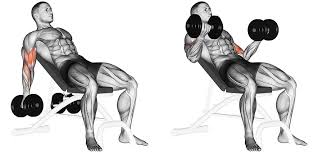
The incline dumbbell curls is one of the most underrated biceps exercises in the gym. By lying back on an incline bench, your arms hang behind your body rather than in front — and this simple change in position creates a deeper stretch on the long head of the biceps than almost any other curl variation can achieve.
If you want that sharp, full biceps peak, the incline curl deserves a place in your routine alongside your regular curls.
Why the Incline Position Makes a Difference
This is what sets the incline curl apart from every other curl variation:
When you sit or stand upright for curls, your arms hang in front of your body and the biceps start in a relatively shortened position. On an incline bench, your arms hang behind your torso — this puts the long head of the biceps in a fully stretched position at the bottom of the movement. Training a muscle through a full stretch is one of the most powerful stimuli for muscle growth, which is why the incline curl is particularly effective for building biceps peak and length.
Compare this to the preacher curl which loads the biceps at a shortened position, or standard curls which are more neutral — the incline curl fills a gap that those exercises leave. Check out our Dumbbell Curls page for the standard standing version.
Incline Dumbbell Curls – Muscles Worked
Primary muscles:
- Biceps brachii (long head) — the outer head of the bicep, particularly emphasized due to the stretched starting position. The long head is what creates that bicep peak.
- Biceps brachii (short head) — the inner head is also worked throughout the curl
Secondary muscles:
- Brachialis — heavily involved throughout the curl, adds thickness under the bicep
- Brachioradialis — forearm muscle that assists with the curl
- Core — works to keep your back against the bench throughout the movement
How to Perform Incline Dumbbell Curls
- Set an incline bench to around 45–60 degrees — a steeper incline means less stretch, a shallower angle means more stretch. 45 degrees is a good starting point for most people.
- Sit back against the bench with a dumbbell in each hand, arms hanging freely at your sides. Your palms should face forward (underhand grip).
- Let your arms hang fully — feel the stretch in your biceps at this starting position. This is the unique part of the exercise — don’t rush past it.
- Curl both dumbbells upward simultaneously by bending your elbows, keeping your upper arms as still as possible and your back against the bench.
- Curl until your forearms are roughly vertical and squeeze your biceps hard at the top.
- Slowly lower the dumbbells back to the fully hanging position over 2–3 seconds, feeling the stretch at the bottom.
- Repeat for your desired reps.
Incline Dumbbell Curls Pro tip: Don’t let your shoulders roll forward as your arms hang at the bottom. Keep your shoulders back and pinned to the bench — this maximizes the stretch on the long head and keeps the tension in the biceps rather than the shoulder joint.
Incline Dumbbell Curls – Sets & Reps
| Goal | Sets | Reps | Rest |
|---|---|---|---|
| Muscle building | 3–4 | 8–12 | 60–90 sec |
| Stretch focused | 3 | 10–15 | 60 sec |
| Superset addition | 2–3 | 12–15 | Minimal |
Incline Dumbbell Curls – Common Mistakes to Avoid
1. Bench angle too steep If the bench is set too high (close to 90 degrees) your arms hang almost straight down — similar to a standing curl — and you lose the stretch that makes this exercise special. Set the bench between 45–60 degrees for optimal long head stretch.
2. Rushing the starting position Many people immediately curl the moment they get into position without pausing to feel the stretch at the bottom. Take a breath, let your arms fully extend, feel the biceps stretch — then curl. That stretched starting position is the whole point.
3. Upper arms swinging forward Your upper arms should stay relatively still and pointed downward throughout the curl. If they swing forward as you curl, you’re using your shoulders to help rather than isolating the bicep. Keep your shoulders pinned to the bench.
4. Not lowering fully The full hang at the bottom is where the long head stretch happens. Stopping your reps short of full arm extension defeats the purpose of the incline position entirely. Lower all the way down every rep.
5. Going too heavy The stretched position of incline curls puts the biceps tendon under significant stress at the bottom of the movement. Going too heavy here — especially with a jerky motion — is a fast track to biceps tendon strain. Use a moderate weight and prioritize the stretch and contraction over loading up.
Incline Dumbbell Curls – Bench Angle Guide
The angle of the bench significantly changes the exercise:
- 45 degrees — maximum stretch on the long head, most challenging, best for building peak
- 60 degrees — moderate stretch, slightly easier, good middle ground
- 75–90 degrees — minimal stretch, essentially a seated standard curl, not much different from standing
Start at 45–60 degrees and experiment to find the angle where you feel the most stretch in your biceps at the bottom of the movement.
Where It Fits in Your Workout
The incline dumbbell curls is a stretch-focused isolation exercise and works best in the middle of your biceps session — after heavier compound curl work like barbell curls, but before finishing moves like cable curls or concentration curls. Because of the biceps tendon stress at the bottom, it’s worth doing when your muscles are warmed up but not completely fatigued.