
Dumbbell Lunges: How To, Muscles Worked & Common Mistakes
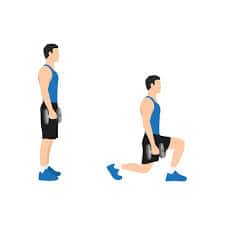
Dumbbell lunges are one of the best unilateral leg exercises you can do — meaning they train one leg at a time, which makes them uniquely valuable for building balanced lower body strength. Unlike squats and leg press which work both legs simultaneously, lunges force each leg to work independently, helping to identify and correct any strength or size imbalances between your left and right side.
They also challenge your balance and coordination in a way that machine exercises simply can’t replicate, making them one of the most functional lower body exercises in your arsenal.
Dumbbell Lunges – Muscles Worked
Primary muscles:
- Quadriceps — the front of the thigh does the bulk of the work extending the knee on every rep
- Glutes — heavily engaged throughout, especially the glute of the front leg driving you back to standing
- Hamstrings — assist with hip extension throughout the movement
Secondary muscles:
- Adductors — the inner thigh stabilizes your hip throughout the lunge
- Calves — work as stabilizers throughout
- Core — works continuously to keep your torso upright and prevent lateral sway
- Hip flexors — stretched on the trailing leg at the bottom of each lunge
How to Perform Dumbbell Lunges
- Stand upright with a dumbbell in each hand at your sides, feet hip-width apart.
- Take a controlled step forward with one leg — a stride length where your front shin stays roughly vertical when your knee is bent.
- Lower your body by bending both knees simultaneously until your front thigh is roughly parallel to the floor and your back knee hovers just above the ground — don’t let it slam down.
- Your front knee should be directly above your ankle — not shooting past your toes.
- Push through your front heel to drive yourself back up to the starting position.
- Bring your front foot back to the starting position and repeat with the opposite leg.
- Continue alternating legs for your desired number of reps.
Dumbbell Lunges Pro tip: Your stride length matters more than most people realize. Too short a step causes your front knee to shoot far past your toes, putting excessive stress on the knee joint. Too long a step makes it hard to drive back up effectively. The sweet spot is a stride where your front shin stays close to vertical when your thigh reaches parallel — experiment to find your ideal length.
Dumbbell Lunges – Sets & Reps
| Goal | Sets | Reps | Rest |
|---|---|---|---|
| Muscle building | 3–4 | 10–12 per leg | 90 sec |
| Strength | 4 | 6–8 per leg | 2 min |
| Endurance / conditioning | 3 | 15–20 per leg | 60 sec |
Dumbbell Lunges – Common Mistakes to Avoid
1. Front knee caving inward Just like squats, the front knee should track in line with your toes throughout the lunge. Collapsing inward puts stress on the knee joint and indicates weak glutes or adductors. Focus on pushing your knee outward as you lower and drive back up.
2. Torso leaning too far forward A slight forward lean is natural and fine, but collapsing your torso significantly forward shifts the load away from your quads and glutes and onto your lower back. Keep your chest up and core engaged throughout.
3. Back knee slamming into the floor Controlling the descent matters — your back knee should hover just above the floor, not crash into it. Slow the lowering phase down to 2–3 seconds to build the eccentric strength that controls this.
4. Front foot too close to back foot If your stride is too short, you’ll feel unstable and your front knee will travel far past your toes. Take a full stride forward so you have a solid, stable base at the bottom position.
5. Pushing off the back foot instead of the front You should be driving back to standing primarily through your front heel — not pushing off your back toes. If you’re relying on your back leg to get back up, your front leg isn’t doing the work it should be.
6. Looking down at the floor Keep your gaze forward and your chin up throughout. Looking down causes your chest to drop and your torso to lean forward, which throws off your balance and form.
Dumbbell Lunges – Variations
Lunges are one of the most versatile lower body exercises — the same basic movement can be modified in many ways to change the emphasis or difficulty:
- Walking lunges — instead of returning to the starting position, step your back foot forward into the next lunge and walk forward continuously. Great for conditioning and adding variety.
- Reverse lunges — step backward instead of forward. Reduces knee stress and is often more comfortable for people with knee issues.
- Lateral lunges — step out to the side instead of forward. Targets the adductors and glutes from a different angle.
- Deficit lunges — front foot elevated on a small platform, increases the range of motion and glute stretch at the bottom.
- Barbell lunges — same movement with a barbell on your back instead of dumbbells, allows heavier loading.
Where Dumbbell Lunges Fit in Your Workout
Dumbbell lunges work well as a secondary compound exercise on leg day, after your primary bilateral movements like squats and leg press. Because they’re unilateral they take more total time than bilateral exercises, so factor that into your session planning. They also work very well as a standalone exercise on a conditioning or bodyweight training day when you want challenging lower body work without heavy equipment.