

V-Bar Pulldown: How To, Muscles Worked & Common Mistakes
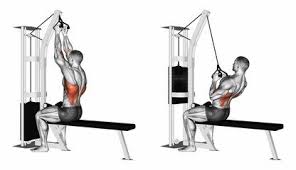
The V-bar pulldown is a lat pulldown variation that uses a narrow, neutral grip attachment instead of the wide bar. That small change makes a surprisingly big difference — the neutral grip (palms facing each other) is a more natural and comfortable position for most people, allows a longer range of motion, and places slightly more emphasis on the lower lats and middle back compared to the wide-grip version.
If you find the wide-grip pulldown uncomfortable on your wrists or shoulders, the V-bar is often a much more comfortable alternative that delivers excellent results.
How The V-Bar Pulldown Differs from the Wide-Grip Pulldown
Both exercises work the same primary muscles, but the grip and attachment change the feel significantly:
- Wide-grip lat pulldown — overhand wide grip, emphasizes the outer lats and back width, slightly shorter range of motion
- V-bar pulldown — narrow neutral grip, emphasizes the lower lats and middle back, longer range of motion, more comfortable on the wrists and shoulders
Neither is strictly better — they complement each other well and it’s worth including both in your training at different points. Check out our Wide-Grip Lat Pulldown page for a full comparison.
V-Bar Pulldown – Muscles Worked
Primary muscles:
- Latissimus dorsi (lower portion) — the narrow grip allows your elbows to travel closer to your sides, hitting the lower lats more directly
- Teres major — assists throughout the pulling motion
Secondary muscles:
- Rhomboids and mid trapezius — squeezed together at the bottom of each rep
- Rear deltoids — secondary involvement throughout
- Biceps brachii — significantly involved due to the neutral grip position
- Core — stabilizes your torso throughout
How to Perform the V-Bar Pulldown
- Attach the V-bar handle to the pulldown machine and sit down, securing your thighs under the knee pad.
- Reach up and grab both sides of the V-bar with a neutral grip — palms facing each other.
- Sit tall with your chest up and a very slight backward lean — about 10–15 degrees. This is your starting position.
- Pull the V-bar down toward your upper chest by driving your elbows straight down and slightly back, keeping them close to your body throughout.
- Squeeze your lats and middle back hard at the bottom — the V-bar should reach around chin to upper chest height.
- Slowly let the bar rise back to the top, allowing your shoulder blades to spread and your lats to fully stretch.
- Repeat for your desired reps.
Pro tip: Because the neutral grip naturally involves your biceps more, it’s easy to accidentally turn this into an arms exercise. Focus on initiating the pull by depressing your shoulder blades first — almost like trying to put your shoulders in your back pockets before your elbows even start to bend.
V-Bar Pulldown – Sets & Reps
| Goal | Sets | Reps | Rest |
|---|---|---|---|
| Muscle building | 3–4 | 8–12 | 60–90 sec |
| Strength | 4–5 | 5–8 | 2–3 min |
| Endurance | 3 | 15–20 | 45–60 sec |
V-Bar Pulldown – Common Mistakes to Avoid
1. Pulling too low The V-bar should come to your upper chest — not your stomach. Pulling below chest height reduces lat activation and puts your shoulder joints in an awkward position.
2. Letting your elbows flare outward With the V-bar, your elbows should stay close to your sides as you pull down. Flaring them out shifts the work away from the lower lats and turns it into more of a wide-grip movement — defeating the purpose of using the V-bar attachment.
3. Leaning too far back A slight lean is fine and helpful, but rocking your whole torso backward uses momentum instead of muscle. Keep the lean small and consistent throughout every rep.
4. Rushing the return The stretch at the top — when your arms are fully extended and your lats are lengthened — is valuable. Let the bar rise slowly and feel that stretch before initiating the next rep. Don’t let the weight stack pull you upward quickly.
5. Skipping the shoulder blade depression Before every rep, think about pulling your shoulder blades down slightly before you start pulling with your arms. This engages your lats from the very beginning of the movement and stops your upper traps from taking over.
Where It Fits in Your Workout
The V-bar pulldown works well as a secondary compound movement in your back session, typically after heavier free weight work like deadlifts or bent-over rows. Many lifters alternate between the wide-grip and V-bar pulldown across different sessions to hit their lats from different angles, or use the V-bar as a second pulldown variation after the wide grip within the same session.
It also pairs really well with the Seated Cable Row — rows for thickness, pulldowns for width — covering the full back in one efficient pairing.