

Bent-Over Barbell Row: How To, Muscles Worked & Common Mistakes
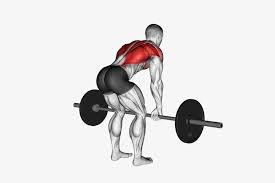
The bent-over barbell row is one of the best exercises you can do for building a thick, strong back. It’s a compound movement that lets you load up heavy weight and work multiple back muscles simultaneously — which is exactly why it’s been a cornerstone of serious training programs forever.
If the bench press is the king of chest exercises, the bent-over barbell row is its back day equivalent.
Bent-Over Barbell Row – Muscles Worked
The bent-over barbell row primarily targets:
- Latissimus dorsi — the large wing-shaped muscles that give your back its width
- Rhomboids — the muscles between your shoulder blades, squeezed hard at the top of each rep
- Trapezius — the upper and mid traps assist throughout the pulling motion
- Rear deltoids — the back of your shoulders get solid secondary work
- Biceps brachii — assist with pulling the bar toward your body
Secondary muscles:
- Erector spinae — work isometrically to keep your back straight throughout
- Core — braces to stabilize your torso in the hinged position
How to Perform the Bent-Over Barbell Row
- Stand with your feet shoulder-width apart, barbell on the floor or in a rack at about knee height.
- Grip the barbell with an overhand grip (palms facing down), hands just outside shoulder width.
- Hinge at your hips and push them back, keeping your back straight and chest up. Your torso should be roughly parallel to the floor, or at around 45 degrees — both work, but more horizontal = more lat involvement.
- Let the bar hang at arm’s length below your chest — this is your starting position.
- Pull the bar toward your lower chest/upper abdomen by driving your elbows back, keeping them relatively close to your sides.
- Squeeze your shoulder blades together hard at the top of the movement.
- Lower the bar back down in a controlled manner — don’t just drop it.
- Repeat for your desired reps.
Pro tip: Think about driving your elbows back rather than pulling the bar up. This mental cue shifts the focus to your back muscles instead of letting your biceps take over.
Bent-Over Barbell Row – Sets & Reps
| Goal | Sets | Reps | Rest |
|---|---|---|---|
| Muscle building | 3–4 | 6–12 | 90 sec – 2 min |
| Strength | 4–5 | 3–6 | 3–5 min |
| Endurance | 3 | 15–20 | 60 sec |
Bent-Over Barbell Row – Common Mistakes to Avoid
1. Rounding your lower back This is the most important one. A rounded lower back under load is a recipe for injury. Before every set, take a breath, brace your core, and make sure your chest is up and your spine is neutral. If your back rounds when you pull, the weight is too heavy.
2. Using momentum to swing the weight up Jerking your torso upward to help lift the bar means your back muscles aren’t doing the work — your lower back is. Use a weight you can control strictly and the results will be far better.
3. Pulling to the wrong spot Pulling the bar to your upper chest shifts the work to your upper traps and rear delts. Pulling to your lower chest or upper abdomen keeps the lats more involved. Experiment with what you feel most in your back.
4. Not squeezing at the top The contraction at the top of the movement is where a lot of the back development happens. Don’t just pull and release — hold the squeeze for a moment before lowering.
5. Gripping too wide A grip that’s too wide reduces your range of motion and limits how far back you can pull your elbows. Just outside shoulder width is the sweet spot for most people.
Overhand vs. Underhand Grip
The bent-over row can be performed with two different grips:
- Overhand grip (pronated) — palms facing down, what we’ve covered above. Emphasizes the upper back, traps, and rear delts more.
- Underhand grip (supinated) — palms facing up, allows your elbows to stay tighter to your body. Shifts more emphasis to the lower lats and biceps.
Check out our Reverse Grip Bent-Over Row page for a full breakdown of the underhand variation.
Where It Fits in Your Workout
The bent-over barbell row is a compound movement so it belongs near the beginning of your back session when you have the most energy and strength. A solid back day might look like: Bent-Over Row → Pull-Ups → Lat Pulldown → Seated Cable Row → finishing isolation work.