

Incline Dumbbell Curls: How To, Muscles Worked & Common Mistakes
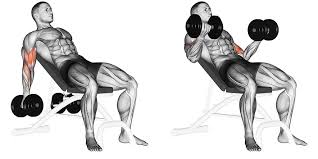
Table of Contents
The incline dumbbell curl is one of the most underrated biceps exercises in the gym. Lying back on an incline bench lets your arms hang behind your body rather than in front of it — and this simple change of position stretches the long head of the biceps further than almost any other curl.
If you want bigger, fuller biceps, the incline curl deserves a place in your routine alongside your regular curls.
Why the Incline Position Makes a Difference
This is what sets the incline curl apart from other curl variations:
When you sit or stand upright for curls, your arms hang down at your sides. On an incline bench, your arms hang behind your torso. Because the long head of the biceps attaches above your shoulder joint, taking your arms behind you stretches it at the shoulder as well as the elbow — so at the bottom of each rep, it’s in a fully stretched position. Training a muscle in its stretched position is a particularly effective stimulus for growth, which is why the incline curl is so valuable for building your biceps.
It pairs well with the preacher curl, which loads the biceps hardest at the bottom of the curl, in a stretched position at the elbow — while the incline curl adds extra stretch at the shoulder for the long head. Check out our Dumbbell Curls page for the standard standing version.
Incline Dumbbell Curls – Muscles Worked
Primary muscles:
- Biceps brachii (long head) — the outer head of the biceps, emphasized by the stretched starting position
- Biceps brachii (short head) — the inner head also works throughout the curl
Secondary muscles:
- Brachialis — heavily involved throughout the curl, adding thickness under the biceps
- Brachioradialis — a forearm muscle that assists with the curl
- Core — works to keep your back against the bench throughout the movement
How to Perform Incline Dumbbell Curls
- Set an incline bench to around 45–60 degrees — a more upright bench gives less stretch, a lower angle more. 45 degrees is a good starting point for most people.
- Sit back against the bench with a dumbbell in each hand, arms hanging freely at your sides. Your palms should face forward (underhand grip).
- Let your arms hang fully and feel the stretch in your biceps in this starting position. This is the unique part of the exercise — don’t rush past it.
- Curl both dumbbells up together by bending your elbows, keeping your upper arms as still as possible and your back against the bench.
- Curl until your forearms are just short of vertical, and squeeze your biceps hard at the top.
- Slowly lower the dumbbells back to the fully hanging position over 2–3 seconds, feeling the stretch at the bottom.
- Repeat for your desired number of reps.
Incline Dumbbell Curls Pro tip: Don’t let your shoulders roll forward as your arms hang at the bottom. Keep your shoulders back and pinned to the bench — this keeps the stretch on the long head of your biceps and the tension in your biceps rather than your shoulder joint.
Incline Dumbbell Curls – Sets & Reps
| Goal | Sets | Reps | Rest |
|---|---|---|---|
| Muscle building | 3–4 | 8–12 | 60–90 sec |
| Stretch focused | 3 | 10–15 | 60 sec |
| Superset addition | 2–3 | 12–15 | Minimal |
Incline Dumbbell Curls – Common Mistakes to Avoid
1. Bench angle too steep If the bench is set too upright (close to 90 degrees), your arms hang almost straight down — similar to a standing curl — and you lose the stretch that makes this exercise special. Set the bench between 45 and 60 degrees for a good long head stretch.
2. Rushing the starting position Many people curl the moment they get into position, without pausing to feel the stretch at the bottom. Take a breath, let your arms fully extend, feel your biceps stretch — then curl. That stretched starting position is a big part of what makes this exercise effective.
3. Upper arms swinging forward Your upper arms should stay fairly still and pointed down throughout the curl. If they swing forward as you curl, your shoulders are helping instead of your biceps doing the work. Keep your shoulders pinned to the bench.
4. Not lowering fully The full hang at the bottom is where the long head stretch happens. Stopping short of full arm extension gives up much of the benefit of the incline position. Lower all the way down on every rep.
5. Going too heavy The stretched position at the bottom of incline curls puts extra stress on the biceps tendon. Going too heavy here — especially with a jerky motion — can strain it. Use a moderate weight and prioritize the stretch and the squeeze over loading up. If the deep stretch bothers the front of your shoulder, raise the bench a little.
Incline Dumbbell Curls – Bench Angle Guide
The angle of the bench changes the exercise significantly:
- 45 degrees — the most stretch on the long head, and the most challenging
- 60 degrees — a moderate stretch, slightly easier — a good middle ground
- 75–90 degrees — minimal stretch; essentially a seated standard curl, not much different from standing
Start at 45–60 degrees and experiment to find the angle where you feel the most stretch in your biceps at the bottom of the movement, without discomfort in your shoulders.
Where It Fits in Your Workout
The incline dumbbell curl is a stretch-focused isolation exercise and works best in the middle of your biceps session — after heavier curl work like barbell curls, but before finishing moves like cable hammer curls or concentration curls. Because of the stress on the biceps tendon at the bottom, it’s best done when your muscles are warmed up but not completely fatigued. For a complete plan, see our guide to the best biceps exercises.