
Lying Leg Curls: How To, Muscles Worked & Common Mistakes
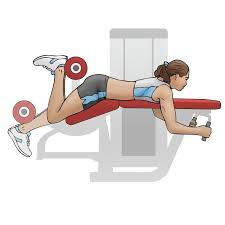
The lying leg curls is the most direct isolation exercise for the hamstrings. While compound movements like squats and deadlifts do work the hamstrings, they never fully isolate them — the lying leg curl fixes that by targeting the hamstrings exclusively through their primary function: flexing the knee. If you want well-developed, strong hamstrings that balance out your quad development and protect your knees long term, this exercise is a non-negotiable part of your leg training.
Lying Leg Curls – Muscles Worked
Primary muscles:
- Biceps femoris — the largest of the three hamstring muscles, the main driver of knee flexion on every rep
- Semitendinosus — the middle hamstring muscle, heavily involved throughout
- Semimembranosus — the inner hamstring muscle, contributes throughout the curl
Secondary muscles:
- Gastrocnemius (calves) — the calf muscle crosses the knee joint and assists with knee flexion during the curl
- Popliteus — a small muscle behind the knee that assists with the initial bending motion
How to Perform Lying Leg Curls
- Lie face down on the leg curl machine. Adjust the pad so it sits just above your heels — on the lower part of your calves — not on your ankles.
- Make sure your knees are just at the edge of the bench pad, in line with the machine’s pivot point. This is the key setup adjustment.
- Grip the handles at the sides of the machine for stability. Keep your hips and torso flat against the bench throughout.
- Curl your legs upward by bending your knees, bringing the pad as close to your glutes as possible.
- Squeeze your hamstrings hard at the top of the movement — hold briefly.
- Slowly lower the pad back to the starting position over 2–3 seconds — don’t let it drop.
- Repeat for your desired reps.
Lying Leg Curls Pro tip: Plantarflex your ankles — point your toes away from you — as you curl. This slight ankle position change places the gastrocnemius in a shortened position, reducing its contribution to the movement and shifting more of the work directly onto the hamstrings. It’s a subtle cue that makes a noticeable difference in where you feel the exercise.
Lying Leg Curls – Sets & Reps
| Goal | Sets | Reps | Rest |
|---|---|---|---|
| Muscle building | 3–4 | 10–15 | 60–90 sec |
| Strength | 4 | 6–8 | 90 sec – 2 min |
| Definition / pump | 3–4 | 15–20 | 45–60 sec |
Lying Leg Curls – Common Mistakes to Avoid
1. Hips lifting off the bench This is the most common lying leg curl mistake. When your hips rise as you curl, your lower back and glutes start helping the movement — your hamstrings do less work and your lower back takes unwanted stress. Keep your hips pressed firmly into the bench throughout every rep.
2. Using momentum to swing the weight up Jerking the weight up with a quick snap removes the load from your hamstrings at the most important phase of the movement. Use a smooth, controlled curl — 2 seconds up — and feel the hamstring working throughout.
3. Not curling high enough Your goal is to bring the pad as close to your glutes as possible on every rep. Stopping halfway reduces the hamstring contraction significantly. Aim for the fullest range of motion your flexibility allows.
4. Dropping the weight too fast The slow lowering phase is where a lot of the hamstring development happens — the eccentric stretch under load. Lower over 2–3 seconds every rep and you’ll feel the difference immediately.
5. Pad positioned incorrectly If the pad is resting on your ankles rather than your lower calves, it puts uncomfortable pressure on the ankle joint and changes the leverage. Position it just above the ankle on the lower calf for optimal comfort and muscle activation.
6. Knees not at the bench edge If your knees are too far back on the bench, the range of motion is limited and the leverage is off. Your knees should align with the edge of the bench pad and the machine’s pivot point.
Lying Leg Curls – Foot Angle Variations
Like the leg extension, small adjustments to foot position change the emphasis within the hamstrings:
- Toes pointed away (plantarflexed) — reduces calf contribution, more direct hamstring isolation
- Toes pulled toward shins (dorsiflexed) — increases calf contribution to the curl
- Toes pointed inward — shifts slightly more emphasis to the outer hamstring (biceps femoris)
- Toes pointed outward — shifts slightly more emphasis to the inner hamstrings (semitendinosus, semimembranosus)
Most people use a neutral or slightly plantarflexed position for maximum hamstring isolation.
Where It Fits in Your Workout
Lying leg curls are an isolation exercise and belong toward the end of your leg session after compound movements like squats, leg press, and lunges. They pair perfectly in a superset with leg extensions — quads and hamstrings back to back — for an efficient and thorough leg finishing circuit.