

Dumbbell Side Bend: How To, Muscles Worked & Common Mistakes
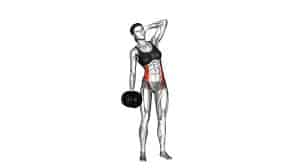
The dumbbell side bend is the most direct isolation exercise for the obliques — the muscles running diagonally along the sides of your abdomen. While most ab exercises focus on the rectus abdominis at the front, the obliques are equally important for a complete, strong, and well-defined core. They’re responsible for lateral flexion, rotation, and stabilizing your spine during virtually every movement you do in the gym and in daily life.
Strong obliques don’t just look good — they make you better at squats, deadlifts, presses, and almost every other exercise by providing lateral stability to your torso.
Dumbbell Side Bend – Muscles Worked
Primary muscles:
- External obliques — the outermost layer of the oblique muscles, running diagonally from the ribs toward the hips. The side bend directly works the oblique on the side you’re bending toward.
- Internal obliques — the deeper layer beneath the external obliques, also heavily involved throughout the movement
Secondary muscles:
- Quadratus lumborum — a deep lower back muscle that assists with lateral flexion
- Erector spinae — works on the opposite side to stabilize and control the return
- Transverse abdominis — braces throughout to support the spine
How to Perform the Dumbbell Side Bend
- Stand upright with your feet shoulder-width apart, holding a dumbbell in one hand at your side. Your free hand can rest on your hip or be held behind your head.
- Stand tall — chest up, shoulders back, core lightly braced. This is your starting position.
- Keeping your torso facing directly forward — no twisting or rotating — slowly bend directly to the side of the dumbbell, sliding it down toward your knee along your thigh.
- Lower until you feel a solid stretch in your oblique on the opposite side.
- Contract your oblique on the dumbbell side to pull yourself back upright.
- Complete all reps on one side, then switch the dumbbell to the other hand and repeat.
Dumbbell Side Bend Pro tip: Think of this as a pure side-to-side movement — like a hinge in the frontal plane. Your torso should not rotate forward or backward at any point. Imagine your back is pressed against a wall throughout — you can only move side to side, not forward or back.
Dumbbell Side Bend – Sets & Reps
| Goal | Sets | Reps | Rest |
|---|---|---|---|
| Oblique strength | 3–4 | 12–15 per side | 45–60 sec |
| Definition / endurance | 3 | 20–25 per side | 30–45 sec |
| Weighted progression | 3–4 | 10–12 per side | 60 sec |
Dumbbell Side Bend – Common Mistakes to Avoid
1. Leaning forward or backward This is the most important cue — your existing page correctly flags it. The moment your torso rotates forward or backward, you’ve taken the work away from the obliques and started involving your lower back and hip flexors. Focus on a pure lateral bend — side to side only.
2. Bending too fast Using momentum to swing the dumbbell down and bounce back up removes the oblique stretch and contraction entirely. Lower slowly over 2 seconds, feel the stretch at the bottom, then contract your oblique to return. The quality of the contraction matters far more than speed.
3. Not going far enough A very small range of motion means your obliques barely work. Lower the dumbbell until you genuinely feel a stretch in the opposite oblique — for most people this means the dumbbell reaching somewhere between mid-thigh and the knee.
4. Using the same hand position every set Holding the dumbbell with your arm fully extended to your side is the standard position and works well. Some lifters find that holding it slightly in front or to the back changes the feel — experiment to find the angle where you feel the most oblique engagement.
5. Only working one side Always complete equal reps on both sides. Oblique imbalances can develop from consistently doing more work on one side — keep it even every session.
The Waist Width Debate
You may have come across the idea that heavy dumbbell side bends will widen your waist by making your obliques too large. This is worth addressing honestly: the obliques are muscles that can grow with heavy progressive training, and for some people doing very heavy side bends over a long period can add width to their midsection. However, for most people training recreationally with moderate weights, this is not a significant concern. If a narrow waist is a primary aesthetic goal, using lighter weights for higher reps is a sensible approach that builds oblique strength and endurance without prioritizing muscle hypertrophy.
Where It Fits in Your Workout
The dumbbell side bend is an isolation exercise for the obliques and works best at the end of your core session after your primary ab work like crunches, sit-ups, and cable crunches. It pairs well with twisting and cross-body crunch variations to give your obliques a thorough workout from multiple angles — lateral flexion from the side bend, rotation from the twisting exercises.