

Barbell Shoulder Press: How To, Muscles Worked & Common Mistakes
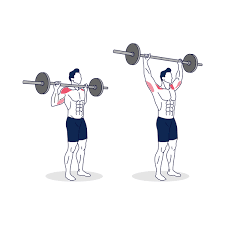
The barbell shoulder press — also known as the overhead press or OHP — is the king of shoulder exercises. It’s a compound movement that builds serious size and strength in your shoulders while also heavily involving your triceps and upper chest. If you want broad, powerful shoulders, this exercise needs to be the foundation of your shoulder training.
It’s one of the few exercises where you’re pressing weight directly overhead, which makes it uniquely demanding and uniquely rewarding.
Barbell Shoulder Press – Muscles Worked
Primary muscles:
- Anterior deltoid — the front of your shoulder does the majority of the pressing work
- Lateral deltoid — the side of your shoulder is heavily involved throughout the press
- Triceps brachii — kicks in powerfully to lock out the movement at the top
Secondary muscles:
- Upper pectoralis major — the upper chest assists at the bottom of the press
- Serratus anterior — stabilizes the shoulder blade throughout
- Core and lower back — work hard to keep your torso upright and stable under the load
- Traps — assist with overhead stability at the top of the movement
How to Perform the Barbell Shoulder Press
Seated version:
- Set a bench to 90 degrees and position a barbell in a rack at upper chest height. Sit down and grip the bar slightly wider than shoulder width, palms facing forward.
- Unrack the bar and hold it at upper chest level — this is your starting position.
- Brace your core and keep your back flat against the bench.
- Press the bar directly upward until your arms are fully extended overhead — don’t lock out your elbows aggressively.
- Lower the bar back to your upper chest slowly and under control.
- Repeat for your desired reps.
Standing version (stricter, more core demand):
- Set the bar in a rack at upper chest height. Grip it slightly wider than shoulder width and unrack it, stepping back.
- Stand with feet shoulder-width apart, core braced, glutes squeezed.
- Press the bar overhead, moving your head slightly back as the bar passes your face, then forward again as it clears — the bar should end up over your mid-foot at the top.
- Lower back to upper chest level and repeat.
Barbell Shoulder Press Pro tip: For the standing version, think about squeezing your glutes and bracing your abs as hard as you can before every rep. This creates a solid base and prevents your lower back from arching excessively under the load.
Barbell Shoulder Press – Sets & Reps
| Goal | Sets | Reps | Rest |
|---|---|---|---|
| Muscle building | 3–4 | 6–12 | 90 sec – 2 min |
| Strength | 4–5 | 3–6 | 3–5 min |
| Endurance | 3 | 15–20 | 60 sec |
Barbell Shoulder Press – Common Mistakes to Avoid
1. Excessive lower back arch This is the most common mistake, especially in the standing version. Arching your lower back aggressively to help press the bar is a sign your core isn’t braced properly — and it puts serious strain on your lumbar spine. Squeeze your glutes and brace your core before every single rep.
2. Bar path too far forward The bar should travel in a straight vertical line over your mid-foot. If it drifts forward as you press, you lose mechanical advantage and your shoulders take on extra strain. Keep the path as vertical as possible.
3. Flaring elbows too wide Your elbows should be slightly in front of the bar at the starting position — not flared out to the sides. Elbows pointing forward keeps the shoulder joint in a safer, stronger position.
4. Pressing in front of your face The bar should travel directly overhead — not out in front of you. Pressing forward rather than straight up reduces how much weight you can handle and puts unnecessary stress on the shoulder joint.
5. Gripping too wide A grip too far outside shoulder width reduces your pressing strength and can cause wrist discomfort. Just outside shoulder width is the optimal position for most people.
6. Rushing the lowering phase Control the bar on the way down. Dropping it quickly removes the eccentric stimulus from your shoulders and makes the exercise less effective overall.
Seated vs. Standing
Both versions are effective but they each have their place:
- Seated — back supported, allows slightly heavier loads, less core demand, great for beginners or when focusing purely on shoulder strength
- Standing — no back support, requires full body stability, greater core and stabilizer involvement, more functional carry-over to athletic performance
Many lifters do the seated version when going heavy for strength and the standing version at lighter loads for more total body engagement.
Barbell Shoulder Press – Variations
The barbell shoulder press is the foundation, but you have other pressing variations on your site that complement it well:
- Arnold Press — dumbbell variation with a rotational movement that hits all three deltoid heads.
- Handstand Push-Ups — advanced bodyweight overhead pressing.
Where It Fits in Your Workout
The barbell shoulder press is your primary compound movement on shoulder day and should always come first while your energy and strength are at their peak. Follow it up with isolation work like lateral raises, front raises, and rear delt exercises to round out your shoulder development completely.