

Proline
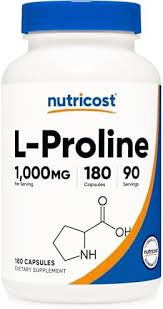
Table of Contents
Proline is a non-essential amino acid — the body makes it, so you don’t need to track it in your diet. Its practical importance is straightforward: together with glycine, it’s one of the main building blocks of collagen, the structural protein of tendons, ligaments, cartilage, bone, and skin. About 12–13% of the amino acids in collagen are proline, and a similar share are hydroxyproline, a modified form of proline. That makes proline one of the most structurally important amino acids in the body, even though it’s rarely discussed in fitness circles. For anyone training seriously, the practical questions are how collagen is built and maintained, and what nutrition can — and can’t — do to support it.
Classification
- Type: Non-essential amino acid — the body makes proline from glutamate, and also from arginine via ornithine, so there’s no dietary requirement in normal circumstances
- Unique structure: Proline is the only standard amino acid whose side chain loops back and bonds to its own nitrogen, forming a rigid ring. This ring creates kinks and constraints in protein chains, which is what allows collagen’s chains to coil tightly into its rope-like structure
- Metabolism: Glucogenic — proline can be converted into glutamate, which enters the Krebs cycle for energy
What Proline Does
Collagen — the main story:
Collagen is the most abundant protein in the body. It gives tendons their tensile strength, ligaments their stability, cartilage its resilience, bone its flexible framework, and skin its firmness. Each collagen molecule is made of three protein chains wound together into a triple helix. Glycine occupies every third position along each chain, and proline and hydroxyproline fill many of the other positions, with their rigid rings helping lock the chains into the helix shape.
Hydroxyproline is proline that has been modified after being built into a collagen chain, by the enzyme prolyl hydroxylase, which needs vitamin C, iron, and oxygen. Hydroxyproline stabilizes the triple helix, so collagen holds together at body temperature. (The cross-links that join collagen molecules into strong fibers are a separate step, made from lysine by a copper-dependent enzyme.) This is why vitamin C deficiency causes scurvy: without enough hydroxyproline, collagen is unstable and is poorly made and maintained, so gums, blood vessels, skin, and wounds start to break down.
Wound healing:
When tissue is damaged — by injury or surgery — collagen production increases to repair it. Wound tissue makes extra proline, partly from arginine via ornithine, and dietary protein supplies more.
Skin:
Skin is rich in collagen, and its gradual loss with age — accelerated by sun exposure and smoking — contributes to wrinkles and reduced elasticity. This is the basis of collagen supplements marketed for skin. When collagen supplements are digested, some proline-containing fragments (such as the dipeptide prolyl-hydroxyproline) reach the bloodstream intact, and in laboratory studies they can stimulate the cells that make collagen. Many human trials report improvements in skin hydration and elasticity, but most have been funded by manufacturers, and a 2025 meta-analysis found no clear benefit when it looked only at higher-quality, independently funded trials.
Recommended Intake
There’s no RDA for proline — it’s non-essential. People eating enough protein get plenty without any special attention. For athletes interested in tendon and ligament health, gelatin or collagen taken with vitamin C before training is an option with emerging evidence (see below).
Found In (per 100g)
| Food | Proline | Proline (% of protein) |
|---|---|---|
| Parmesan cheese (hard) | 4.18g | 11.7% |
| Cheddar cheese* | 2.68g | 11.1% |
| Turkey breast (roasted) | 1.43g | 4.8% |
| Pumpkin seeds* | 1.32g | 4.4% |
| Beef (ground, 80% lean, cooked) | 1.31g | 5.1% |
| Chicken breast (roasted) | 1.28g | 4.1% |
| Cottage cheese (low-fat)* | 1.16g | 11.1% |
| Peanuts (raw)* | 1.14g | 4.4% |
| Tofu (firm) | 1.08g | 6.3% |
| Pork chop (loin, broiled) | 1.08g | 4.0% |
| Tuna, yellowfin (fresh, cooked) | 0.99g | 3.4% |
| Almonds* | 0.97g | 4.6% |
| Sardines (canned in oil) | 0.87g | 3.5% |
| Salmon (Atlantic, farmed, cooked) | 0.78g | 3.5% |
| Egg (hard-boiled) | 0.50g | 4.0% |
| Oats (dry) | 0.45g | 3.4% |
| Lentils (cooked) | 0.38g | 4.2% |
| Black beans (cooked) | 0.38g | 4.2% |
| Chickpeas (cooked) | 0.37g | 4.1% |
| White rice (cooked) | 0.13g | 4.7% |
Gelatin and collagen are by far the richest sources: USDA data for unflavored gelatin powder show about 12g of proline per 100g. Gelatin also contains roughly as much hydroxyproline, which USDA doesn’t report, so the two together make up around a fifth to a quarter of its weight.
Among everyday foods, dairy stands out: casein, the main protein in milk and cheese, is unusually rich in proline (about 11–12% of its protein), making hard cheeses the richest common food source. Wheat gluten is also proline-rich — its proteins are called “prolamins” because they’re rich in proline and glutamine. Meat provides about 4–5% of its protein as proline, and fish about 3.5%. Bone broth provides proline and glycine from simmered bones and connective tissue, but analyses show the amounts are low and highly variable compared with collagen supplements.
Helps With
- Building and maintaining collagen in tendons, ligaments, cartilage, bone, and skin
- Wound healing and tissue repair
- The structure of blood vessel walls, through collagen
- Protein structure in general — proline’s rigid ring shapes the folds of many proteins
Proline for Athletes and Active People
Connective tissue is one of the more overlooked areas of sports nutrition. Tendons, ligaments, and cartilage take enormous stress during training, and they adapt and heal much more slowly than muscle because they have a poorer blood supply and slower protein turnover.
How slowly connective tissue turns over: studies using carbon dating from nuclear bomb tests found that the core collagen of the adult Achilles tendon is mostly laid down during childhood and adolescence, with little renewal afterwards, and adult cartilage collagen has an estimated half-life of more than 100 years. Tendons do still adapt to training, mainly in their outer regions and through changes in their structure and stiffness — but the idea that cartilage or tendons are being “continuously rebuilt” and simply need more building blocks is too simple.
The gelatin and vitamin C protocol: research from Keith Baar’s lab, published in 2017, tested a targeted approach:
- 15g of gelatin with about 50mg of vitamin C
- Taken about an hour before a short bout of exercise that loads the connective tissue — in the study, six minutes of rope skipping
- The idea is to have collagen’s building blocks circulating in the blood when exercise stimulates collagen production
This doubled a blood marker of collagen production compared with placebo, and the approach has been widely adopted by sports physiotherapists and nutritionists. Evidence that it improves tendon strength or injury outcomes over time is still limited, though some small trials combining collagen peptides with tendon-loading rehabilitation have reported encouraging results. See our vitamin C page for more on this protocol.
Joint comfort: some trials, including one in athletes, found that around 10g of collagen a day for several months modestly reduced activity-related joint pain. Results are mixed, and the effect — if real — is more likely a signalling effect of collagen peptides than simply providing building blocks.
Skin: collagen supplements are widely used for skin, but as noted above, the independent evidence is weaker than marketing suggests.
Proline Deficiency
Dietary proline deficiency doesn’t occur in people eating enough protein — the body makes proline from glutamate and arginine. In severe protein malnutrition, proline falls along with other amino acids, contributing to poor wound healing — but that’s a general protein problem, not a proline-specific one.
Rare inherited disorders: a defect in the first enzyme of proline production (P5CS deficiency) causes loose, wrinkled skin, cataracts, and developmental problems. In prolidase deficiency, the body can’t recycle proline from broken-down collagen fragments, leading to chronic skin ulcers, frequent infections, and other problems. Both illustrate how important proline handling is for connective tissue.
Excessive Proline
No Tolerable Upper Intake Level has been set. Collagen supplements providing 10–20g of collagen a day are generally well tolerated, with occasional digestive upset or a feeling of fullness. As with all supplements, choose products that are third-party tested for quality and contaminants.
Hyperprolinemia is a group of rare inherited conditions in which proline breakdown is impaired, raising blood proline. It’s often harmless, although some forms have been linked to seizures. It’s unrelated to dietary proline intake.
Types and Forms
- L-Proline (free form): available as a supplement but rarely used on its own — most people get proline from protein foods or collagen products.
- Hydrolyzed collagen (collagen peptides): collagen broken into small peptides that dissolve easily in cold drinks. Provides proline, hydroxyproline, and glycine in collagen’s natural proportions, and delivers some collagen-specific peptides into the blood.
- Gelatin: collagen that has been partly broken down by cooking; the same amino acid profile as collagen peptides, but it gels and needs warm liquid to dissolve. It was the form used in the original gelatin and vitamin C study, and it’s usually cheaper.
- Bone broth: a food source of collagen amino acids from simmered bones and connective tissue, but the amounts are low and vary widely between batches.
Which form for your goal:
| Goal | Best approach |
|---|---|
| Tendon and ligament health, or rehab | About 15g of gelatin or collagen with about 50mg of vitamin C, an hour before loading exercise, alongside a proper rehab program |
| Activity-related joint discomfort | Collagen (about 10g a day) is an option with mixed evidence |
| Skin | Sun protection and not smoking first; collagen evidence is mixed |
| Budget option | Unflavored gelatin powder |
| General needs | Adequate protein from varied foods, including dairy |
How to Take Proline
In practice, supporting proline means supporting collagen, rather than taking proline on its own.
For tendons and ligaments: about 15g of gelatin or collagen with roughly 50mg of vitamin C, taken about an hour before exercise that loads the target tissue — such as tendon rehab exercises or a skipping session. Use it alongside a structured, progressive loading program, which is the proven foundation of tendon health.
Vitamin C: collagen production needs vitamin C, which is why it’s paired with gelatin in the protocol. Most people get enough from fruit and vegetables, and the 50mg in the protocol is easy to get from a glass of orange juice or a piece of fruit.
Consistency: connective tissue adapts slowly, so any benefit will build over weeks to months of consistent training and use, not days.
Bone broth: if you enjoy it, long simmering of collagen-rich parts (such as chicken feet, knuckle bones, or pig trotters) extracts more gelatin, but don’t rely on it for consistent doses.
Interactions
Vitamin C is the most important practical interaction — prolyl hydroxylase needs it, along with iron, to convert proline into hydroxyproline in new collagen. Glycine is collagen’s other main amino acid, and collagen products provide both in their natural proportions. Copper is needed for the lysine-based cross-links that join collagen molecules into strong fibers.
Synergy
- Works with glycine as collagen’s main structural amino acids — glycine, proline, and hydroxyproline together make up more than half of collagen’s amino acids.
- Works with vitamin C and iron, which convert proline into hydroxyproline in collagen.
- Works with copper and lysine, which form the cross-links that give collagen fibers their strength.
- Is made from glutamate and from arginine (via ornithine), so adequate total protein supports the body’s own production.
Antagonistic Interactions
- Vitamin C deficiency prevents the conversion of proline into hydroxyproline, leaving collagen unstable — the core problem in scurvy.
- Copper deficiency impairs collagen cross-linking, weakening connective tissue even when proline and vitamin C are adequate.
Food values: USDA FoodData Central, SR Legacy — parmesan, hard (FDC ID 170848); cheddar, sharp, sliced (170899)*; turkey breast, roasted (174516); pumpkin and squash seed kernels, dried (170556)*; ground beef, 80% lean, cooked (171797); chicken breast, roasted (171477); cottage cheese, low-fat, 2% (172182)*; peanuts, raw (172430)*; tofu, firm, calcium-set (172475); pork top loin chop, broiled (167841); yellowfin tuna, cooked (172006); almonds (170567)*; sardines, canned in oil (175139); Atlantic salmon, farmed, cooked (175168); egg, hard-boiled (173424); oats, dry (173904); lentils, cooked (172421); black beans, cooked (173735); chickpeas, cooked (173757); white rice, cooked (168878). * SR Legacy values used as fill-ins for the Foundation Foods entries for cheddar (328637), pumpkin seeds (2515380), cottage cheese (328841), peanuts (2515376), and almonds (2346393), whose amino acid data aren’t included in our tracker. Proline as % of protein is calculated from the same USDA records; the gelatin figure is from USDA SR Legacy data for unflavored gelatin powder.