

Bent-Over Barbell Row: How To, Muscles Worked & Common Mistakes
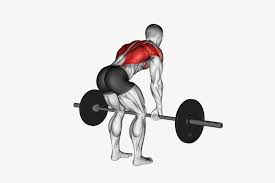
Table of Contents
The bent-over barbell row is one of the best exercises you can do for building a thick, strong back. It’s a compound movement that lets you lift heavy weight and work several back muscles at once — which is exactly why it’s been a cornerstone of serious training programs for decades.
The bent-over barbell row is to back day what the bench press is to chest day.
Bent-Over Barbell Row – Muscles Worked
The bent-over barbell row mainly works:
- Latissimus dorsi — the large, wing-shaped muscles that give your back its width
- Rhomboids — the muscles between your shoulder blades, squeezed hard at the top of each rep
- Trapezius — the upper and middle traps assist throughout the pulling motion
- Rear deltoids — the back of your shoulders gets solid work
- Biceps brachii — assist with pulling the bar toward your body
Secondary muscles:
- Erector spinae — work to hold your back straight throughout
- Core — braces to stabilize your torso in the hinged position
How to Perform the Bent-Over Barbell Row
- Stand with your feet shoulder-width apart, with the barbell on the floor or in a rack at about knee height.
- Grip the barbell with an overhand grip (palms facing down), hands just outside shoulder width.
- Hinge at your hips and push them back, keeping your back straight and chest up. Your torso should be somewhere between roughly parallel to the floor and about 45 degrees. A more horizontal torso gives your back muscles a longer range of motion; a more upright one lets you lift more weight but shifts more of the work to your upper traps.
- Let the bar hang at arm’s length below your chest — this is your starting position.
- Pull the bar toward your lower chest or upper abdomen by driving your elbows back, keeping them relatively close to your sides.
- Squeeze your shoulder blades together hard at the top of the movement.
- Lower the bar back down under control — don’t just drop it.
- Repeat for your desired number of reps.
Pro tip: Think about driving your elbows back rather than pulling the bar up. This mental cue shifts the focus to your back muscles instead of letting your biceps take over.
Bent-Over Barbell Row – Sets & Reps
| Goal | Sets | Reps | Rest |
|---|---|---|---|
| Muscle building | 3–4 | 6–12 | 2–3 min |
| Strength | 4–5 | 3–6 | 3–5 min |
| Endurance | 3 | 15–20 | 60 sec |
For muscle building, finish most sets with one to three good reps still in reserve, and add weight or reps over time
Bent-Over Barbell Row – Common Mistakes to Avoid
1. Losing your back position This is the most important one. Before every set, take a breath, brace your core, and make sure your chest is up and your spine is neutral — it’s your strongest, most stable position for rowing heavy. Your spine isn’t fragile, but if your back rounds more and more as you row, or you can’t hold your position, the weight is too heavy.
2. Using momentum to swing the weight up Jerking your torso upward to help lift the bar means momentum is doing much of the work instead of your back muscles — and it adds stress to your lower back. Use a weight you can control strictly, and your results will be far better.
3. Pulling to the wrong spot Pulling the bar to your upper chest shifts the work to your upper traps and rear delts. Pulling to your lower chest or upper abdomen keeps your lats more involved. Experiment to find where you feel it most in your back.
4. Rushing through each rep Don’t just pull and release. Pause briefly at the top with your shoulder blades squeezed together, then lower the bar under control and let your back muscles stretch fully at the bottom — both ends of the rep count.
5. Gripping too wide A grip that’s too wide reduces your range of motion and limits how far back you can pull your elbows. Just outside shoulder width is the sweet spot for most people.
Overhand vs. Underhand Grip
The bent-over row can be performed with two different grips:
- Overhand grip (pronated) — palms facing down, as covered above. Puts more emphasis on the upper back, traps, and rear delts.
- Underhand grip (supinated) — palms facing up, which keeps your elbows tighter to your body. Shifts a little more of the work onto your lats and biceps.
Check out our Reverse Grip Bent-Over Row page for a full breakdown of the underhand variation.
Where It Fits in Your Workout
The bent-over barbell row is a compound movement, so it belongs near the beginning of your back session, when you have the most energy and strength. A solid back day might look like: Bent-Over Row → Pull-Ups → Lat Pulldown → Seated Cable Row → finishing isolation work.
Because barbell rows also load your lower back, they can be tough to do well when your lower back is already tired — after heavy deadlifts, for example. On those days, the dumbbell row, with one hand braced on a bench, is a great swap. For a complete plan, see our guide to the best back exercises.